



發(fā)布日期:2026-1-25 20:43:48
引言
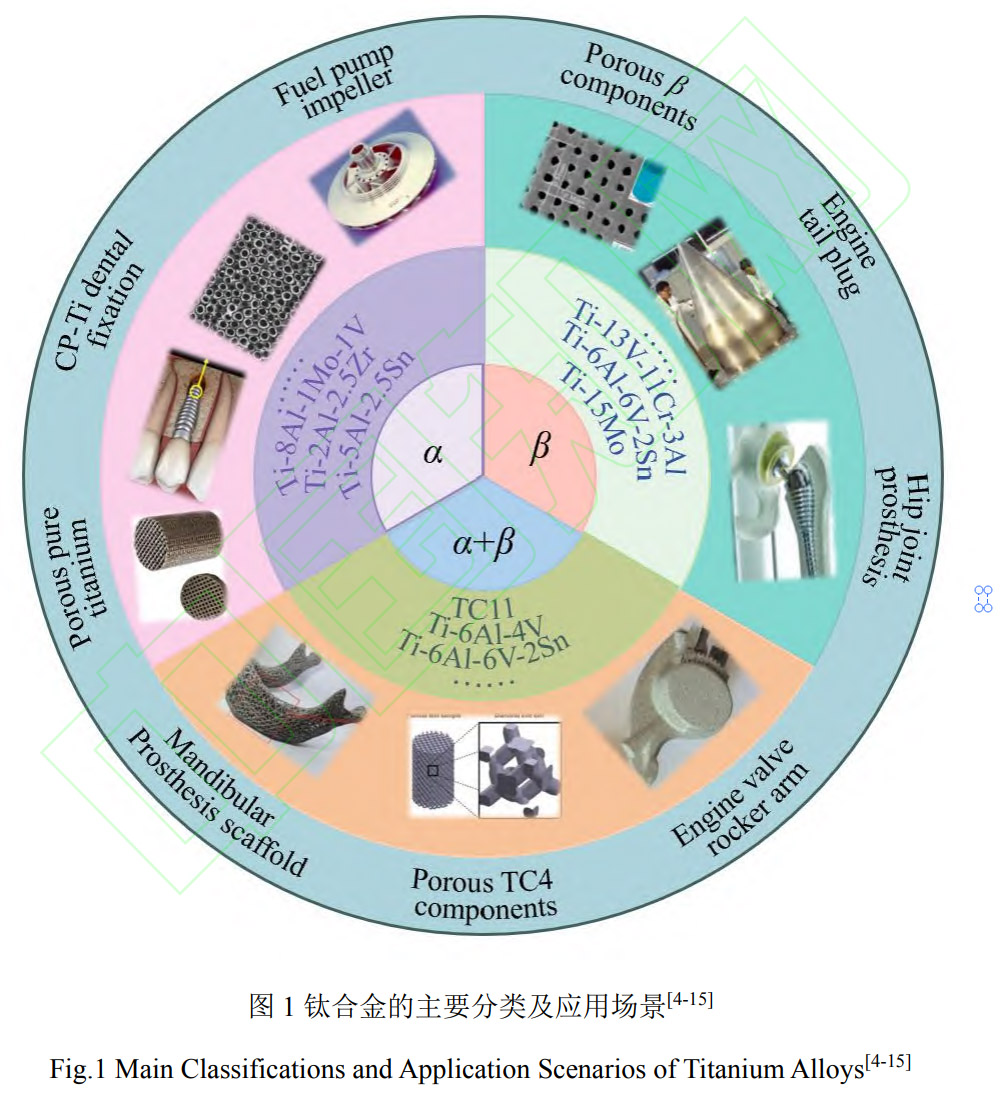
鈦合金(Titanium alloys)憑借其優(yōu)異的比強(qiáng)度、耐腐蝕性和良好的生物相容性,已成為航空航天、海洋工程及生物醫(yī)學(xué)等先進(jìn)工程領(lǐng)域的關(guān)鍵結(jié)構(gòu)材料[1-3]。根據(jù)合金元素及室溫微觀組織特征,鈦合金通常可分為α型[4-7]、α+β型[8-11]和β型[12-15]三類,其選型需緊密結(jié)合具體服役條件與性能要求。圖1鈦合金的主要分類及應(yīng)用場(chǎng)景[4-15]
盡管傳統(tǒng)制造技術(shù)(如鑄造[16]、鍛造[17]、粉末冶金[18]等)在大批量、結(jié)構(gòu)簡(jiǎn)單零件生產(chǎn)中具備可靠性與一致性優(yōu)勢(shì),但仍面臨三大挑戰(zhàn):(1)能源消耗大、碳排放高,與綠色制造理念相悖;(2)熱導(dǎo)率低且高溫化學(xué)活性強(qiáng),易引發(fā)組織缺陷并降低性能;(3)材料利用率低、成本高、加工周期長(zhǎng),難以實(shí)現(xiàn)復(fù)雜曲面結(jié)構(gòu)的高效成型,加工效率與設(shè)計(jì)自由度受限,無(wú)法滿足高性能構(gòu)件需求。隨著制造業(yè)升級(jí)與綠色、可持續(xù)發(fā)展需求,亟需突破傳統(tǒng)技術(shù)瓶頸。近年來(lái),增材制造(AdditiveManufacturing,AM)作為一種革命性成型技術(shù),憑借其低能量損耗、高材料利用率與對(duì)復(fù)雜幾何結(jié)構(gòu)的高度制造柔性等優(yōu)勢(shì),在高性能、高精度鈦合金零部件的一體化制造方面展現(xiàn)巨大優(yōu)勢(shì)。
本文系統(tǒng)闡述了以激光、電弧及復(fù)合能量場(chǎng)為代表的金屬AM技術(shù)在鈦合金構(gòu)件制備中的應(yīng)用現(xiàn)狀,深入分析了工藝參數(shù)優(yōu)化對(duì)鈦合金微觀組織與性能的調(diào)控機(jī)制,闡明了熱處理技術(shù)在改善鈦合金微觀組織及提升力學(xué)性能、腐蝕性能方面的作用機(jī)理,并基于當(dāng)前研究進(jìn)展對(duì)AM鈦合金形性一體化調(diào)控技術(shù)的未來(lái)發(fā)展方向進(jìn)行了展望。
1、鈦合金的增材制造技術(shù)
金屬AM技術(shù)基于“離散+堆積”原理,通過(guò)能量源將金屬原材料逐層熔化、凝固成形,最終實(shí)現(xiàn)三維構(gòu)件的直接制造[19]。根據(jù)能量源類型與原料形態(tài)的差異,適用于鈦合金的主流AM技術(shù)可分為激光定向能量沉積(Laser Directed Energy Deposition,LDED)、激光選區(qū)熔化(Selective Laser Melting,SLM)[20]以及電弧熔絲增材制造(Wire Arc Additive Manufacturing,WAAM)[21]。相關(guān)研究表明[22-25],在金屬AM技術(shù)中引入外場(chǎng)可有效優(yōu)化鈦合金構(gòu)件的成形質(zhì)量和性能,為該領(lǐng)域的發(fā)展提供了重要技術(shù)支撐。
1.1激光定向能量沉積技術(shù)
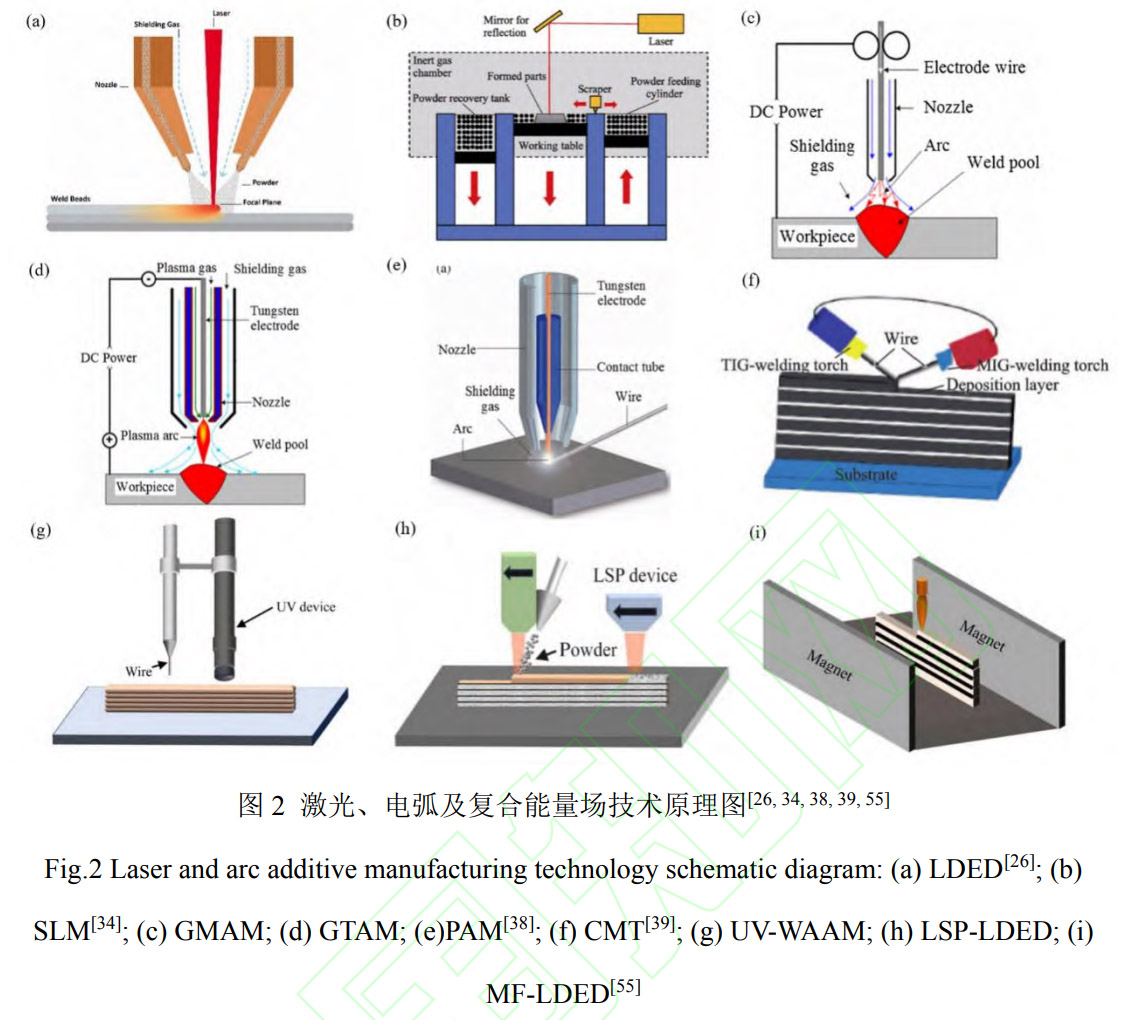
LDED技術(shù),亦稱激光近凈成型技術(shù)(Laser Engineered Net Shaping,LENS),其工藝原理為通過(guò)噴嘴將金屬粉末送至高能激光作用區(qū)域,粉末迅速熔化形成熔池,隨噴嘴與工作臺(tái)的同步移動(dòng)實(shí)現(xiàn)逐層沉積,實(shí)現(xiàn)大型復(fù)雜構(gòu)件的高效成型。圖2激光、電弧及復(fù)合能量場(chǎng)技術(shù)原理圖[26,34,38,39,55]
由于LDED光斑尺寸較大,成形件表面粗糙、尺寸偏差大[27,28]及微裂紋、孔洞等缺陷[29,30]。制約了該技術(shù)的進(jìn)一步應(yīng)用。為此,有必要系統(tǒng)研究不同工藝參數(shù)對(duì)熔覆層成形行為的影響,以實(shí)現(xiàn)鈦合金構(gòu)件形性一體化調(diào)控。當(dāng)前,研究人員圍繞熔覆層成形機(jī)理已開展多項(xiàng)工作[31,32],黃辰陽(yáng)等[33]建立了高精度多物理場(chǎng)數(shù)值模型,模擬了LDED過(guò)程中的激光-粉末-熔池的相互作用與流動(dòng)凝固行為,并通過(guò)TC17合金單道熔覆層實(shí)驗(yàn)驗(yàn)證模型可靠性,基于該模型,系統(tǒng)預(yù)測(cè)了不同工藝參數(shù)下熔覆層形貌與尺寸變化趨勢(shì),揭示了粉末溫度分布和基板能量分配比例對(duì)熔池流場(chǎng)及熔覆尺寸的關(guān)鍵影響,為成形精度控制提供了理論依據(jù)。然而,成形精度不足、組織各向異性等關(guān)鍵問(wèn)題仍亟待解決。后續(xù)可通過(guò)多物理場(chǎng)耦合仿真與實(shí)驗(yàn)相結(jié)合的方式優(yōu)化工藝參數(shù),并借助熱處理調(diào)控組織形貌以提升構(gòu)件性能,最終推動(dòng)大型高性能鈦合金構(gòu)件的精密化制造。
1.2激光選區(qū)熔化技術(shù)
SLM技術(shù),亦稱為激光粉末床熔融(Laser Powder Bed Fusion,LPBF)技術(shù),是一種基于粉末床的AM技術(shù)。其工藝過(guò)程為:首先通過(guò)刮刀或鋪粉輥將金屬粉末均勻平鋪在基板上,隨后高能激光束依據(jù)三維模型的切片數(shù)據(jù)對(duì)粉末層進(jìn)行選區(qū)掃描,使粉末熔化形成熔池,當(dāng)前層成形后,基板下降一個(gè)層厚,重復(fù)進(jìn)行鋪粉與掃描過(guò)程,逐層堆積直至完成整個(gè)構(gòu)建制造[34]。SLM成型過(guò)程中熔池的冷卻速率極高(10~10~8K/s),能有效抑制晶粒生長(zhǎng)和合金元素偏析,在熔池內(nèi)形成細(xì)小均勻的顯微組織,從而提高成形件性能[35]。由于鈦合金化學(xué)活性高、高溫粘性大,SLM為其加工提供良好的成型環(huán)境和技術(shù)路徑[36]。此外,SLM成型過(guò)程中因極高的冷卻速率與逐層堆積帶來(lái)的循環(huán)熱歷史,使構(gòu)件內(nèi)部產(chǎn)生顯著的溫度梯度,進(jìn)而引發(fā)熱收縮不均,最終導(dǎo)致殘余應(yīng)力累積,加劇構(gòu)件變形與開裂風(fēng)險(xiǎn)并降低力學(xué)性能穩(wěn)定性[37]。合適的熱處理工藝可以極大地減小快速凝固成形過(guò)程中的殘余應(yīng)力,改變組織形貌與尺寸等,從而優(yōu)化組織和力學(xué)性能。
1.3電弧熔絲增材制造
WAAM技術(shù)以電弧為熱源將絲材熔化,依據(jù)規(guī)劃路徑逐層堆積成形構(gòu)件。根據(jù)電弧熱源特性,WAAM技術(shù)可分為熔化極氣體保護(hù)焊(Gas Metal Arc Welding, GMAW)、非熔化極氣體保護(hù)焊(Gas Tungsten Arc Welding,GTAW)和等離子弧焊(Plasma Arc Welding,PAW),其基本原理如圖2(c-e)[38]所示。GMAW具備高沉積速率和熱輸入,適用于中大型構(gòu)件制造,但高熱輸入易導(dǎo)致較大溫度梯度,影響界面結(jié)合質(zhì)量。作為其改進(jìn)工藝,冷金屬過(guò)渡焊(Cold Metal Transfer,CMT)技術(shù)(原理如圖2(f)所示[39])通過(guò)精準(zhǔn)控制焊絲回抽將熔滴送進(jìn)熔池,降低熱輸入并抑制飛濺,穩(wěn)定熔池以優(yōu)化成形質(zhì)量[40]。CMT-WAAM技術(shù)憑借加工成本低、沉積效率高等優(yōu)勢(shì),已成功應(yīng)用于TC4 [41, 42]、TC11 [42, 43]、TC17 [44]等中大型金屬結(jié)構(gòu)件的制造。在WAAM沉積過(guò)程中,鈦合金經(jīng)歷快速冷卻時(shí),高溫β相轉(zhuǎn)變?yōu)閬喎�(wěn)相,這類組織易引發(fā)裂紋萌生與擴(kuò)展,最終可能導(dǎo)致構(gòu)件發(fā)生脆性斷裂[45,46]。同時(shí),多層堆積形成的熱積累效應(yīng)會(huì)使導(dǎo)致構(gòu)件內(nèi)部產(chǎn)生顯著的殘余應(yīng)力[47],進(jìn)一步加劇結(jié)構(gòu)失效風(fēng)險(xiǎn)。因此,WAAM沉積態(tài)鈦合金構(gòu)件需通過(guò)后處理工藝調(diào)控微觀組織、優(yōu)化力學(xué)性能并消除殘余應(yīng)力,以滿足工程應(yīng)用需求。
1.4復(fù)合能量場(chǎng)
為了解決AM技術(shù)成型鈦合金過(guò)程中產(chǎn)生的微觀缺陷(裂紋、孔洞等)、殘余應(yīng)力及力學(xué)性能各向異性的問(wèn)題,研究人員提出了外場(chǎng)輔助的方法,通過(guò)外加能場(chǎng)與沉積材料的相互作用來(lái)調(diào)控其微觀組織與力學(xué)性能[48]。輔助外場(chǎng)主要包括聲場(chǎng)(Acoustic field,AF)(超聲波振動(dòng)(Ultrasonic vibration, UV))[49]、形變場(chǎng)(Deformation field, DF)[50](含滾壓(Rolling)[51]、超聲沖擊(Ultrasonic impact treatment, UIT)[52]、激光沖擊(Laser shock peening,LSP)[44]等)及磁場(chǎng)(Magnetic field,MF)[53,54],(圖2(g-i)為各類外場(chǎng)輔助示意圖[55]),其作用原理存在差異:AF利用空化和聲流效應(yīng)消除缺陷和破碎枝晶;DF通過(guò)使沉積層產(chǎn)生塑性變形來(lái)促使材料發(fā)生再結(jié)晶;MF則借助電磁力破碎枝晶來(lái)調(diào)控組織。外場(chǎng)的引入在不同程度上克服了AM的局限性[56],具有易于調(diào)控微觀組織、減小孔隙率、降低殘余應(yīng)力和改善力學(xué)性能等優(yōu)勢(shì)[57,58],為從根本上提升鈦合金的致密度及改善微觀組織開辟了新路徑,SLM工藝因需要在密閉腔體中進(jìn)行,將DF和MF與SLM設(shè)備集成難度較大,相關(guān)研究相對(duì)較少,但可將超聲裝置安裝在基板上,超聲波通過(guò)基板間接作用在熔池中,但隨著樣品高度的增加,聲波振動(dòng)的作用衰減,不適用于尺寸較大的樣品[59]。
上述系統(tǒng)論述了激光、電弧、復(fù)合能量場(chǎng)成型技術(shù)在鈦合金制備中的應(yīng)用現(xiàn)狀,不同技術(shù)因工藝原理的固有差異,在成形精度、沉積效率及構(gòu)件尺寸等方面各具優(yōu)勢(shì),可滿足不同場(chǎng)景下鈦合金構(gòu)件的制備需求。然而,成型工藝及后續(xù)熱處理工藝的選擇對(duì)調(diào)控鈦合金微觀組織特征和服役性能至關(guān)重要。
2、金屬增材制造技術(shù)鈦合金的顯微組織及力學(xué)性能研究
2.1 LDED成型鈦合金顯微組織及力學(xué)性能研究
2.1.1工藝參數(shù)對(duì)LDED成型鈦合金顯微組織及力學(xué)性能的影響
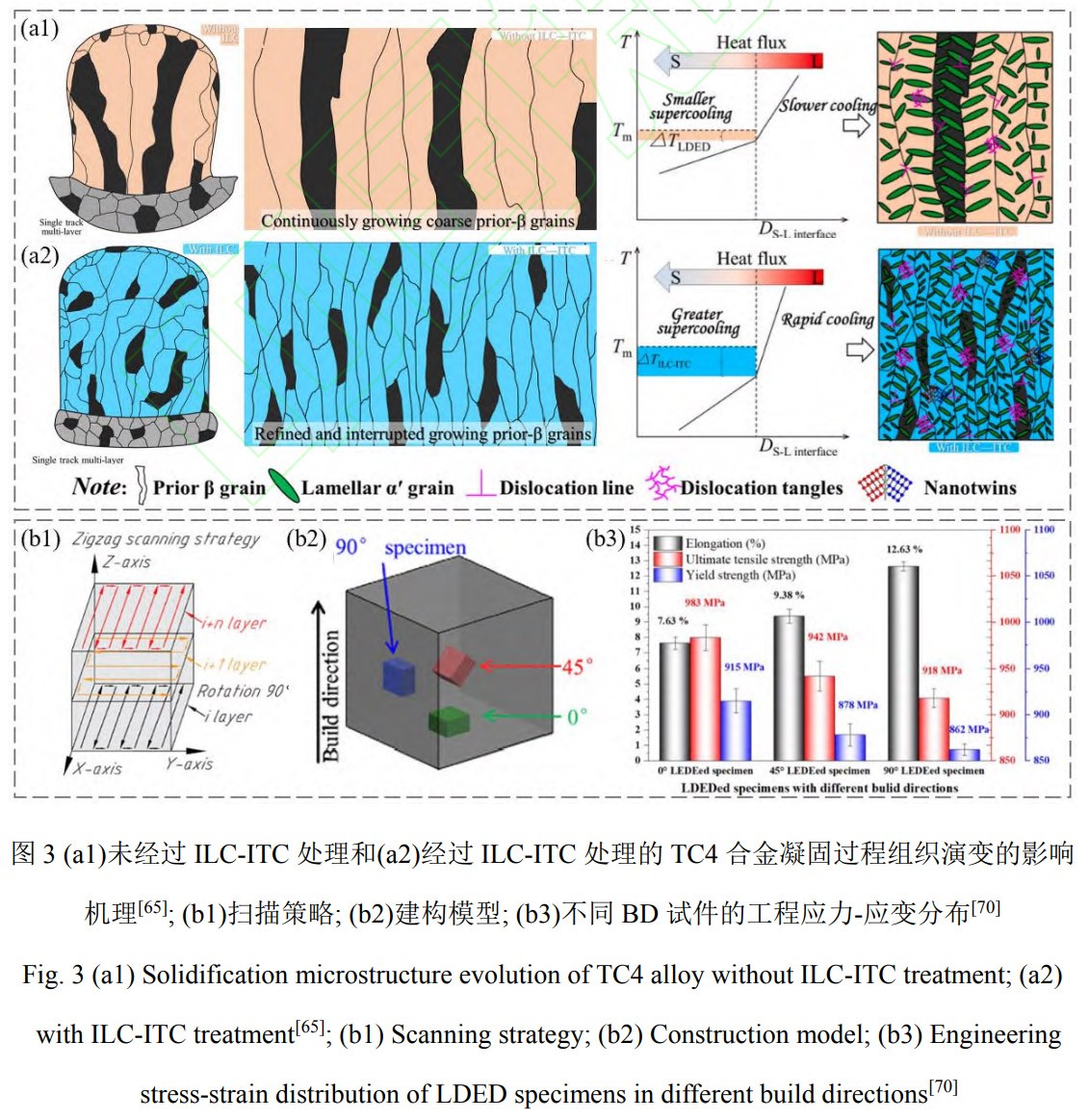
在LDED成形鈦合金過(guò)程中,激光功率(P)、掃描速度(v)、層間溫度、掃描策略等工藝參數(shù),通過(guò)調(diào)控熔池的熱歷史與流動(dòng)行為,直接影響晶粒形態(tài)、相組成及缺陷分布,從而決定構(gòu)件的力學(xué)性能[60-62]。夏超 [63]利用具有高P的LDED技術(shù)成型TA15合金,發(fā)現(xiàn)高P引入的高能量使得沉積態(tài)組織為粗 α板條狀,性能呈現(xiàn)出低強(qiáng)度、高塑性特點(diǎn)。而工藝參數(shù)的協(xié)同作用是實(shí)現(xiàn)力學(xué)性能強(qiáng)塑性平衡的關(guān)鍵,艾佳華 [64]在LDED成型Ti-1300鈦合金過(guò)程中,通過(guò)調(diào)控P、v與送粉速率( P r )等工藝參數(shù),獲得了穩(wěn)定的熔寬和匹配性良好的強(qiáng)塑性。除了優(yōu)化工藝參數(shù)外,層間強(qiáng)制冷卻可降低層間溫度,減少熱積累并細(xì)化晶粒,協(xié)同提升鈦合金的強(qiáng)度和塑性,Wang等[65]采用層間和軌間強(qiáng)制冷卻(Inter Layer Cooling-In Track Cooling, ILC-ITC)6s,阻斷β晶粒的連續(xù)生長(zhǎng)并生成了柱狀β晶粒(圖3(a2)所示),使TC4合金在垂直(0°)與平行(90°)于構(gòu)建方向(Building Direction,BD)的極限抗拉強(qiáng)度(Ultimate Tensile Strength,UTS)和延伸率(Elongation,EL)均顯著提升,實(shí)現(xiàn)強(qiáng)塑性的協(xié)同優(yōu)化。掃描策略對(duì)殘余應(yīng)力、變形行為、及晶粒形態(tài)具有顯著影響[66,67]。Zhang[68]采用數(shù)值模擬方法系統(tǒng)比較了12種掃描路徑的影響規(guī)律,根據(jù)其熱-力耦合仿真結(jié)果表明,層間掃描方向90°旋轉(zhuǎn)有利于降低殘余應(yīng)力,而45°旋轉(zhuǎn)策略則能獲得最優(yōu)的變形控制效果。Wang等[69]在TC4合金成型中采用層內(nèi)反向掃描結(jié)合層間橫縱向交替掃描策略(圖3(b1-b2)),發(fā)現(xiàn)平行于基板的試樣因籃狀 α/α團(tuán)簇結(jié)構(gòu)及更細(xì)小晶粒,展現(xiàn)出最高的 UTS和屈服強(qiáng)度(YieldStrength,YS)、垂直于基板的試樣(90°LDED試樣)則因組織差異獲得最大EL(圖3(b3)所示)。
2.1.2熱處理對(duì)LDED成型鈦合金顯微組織及力學(xué)性能的影響
LDED成型的鈦合金中的典型的粗大柱狀晶組織會(huì)引起力學(xué)性能的顯著各向異性,而殘余應(yīng)力集中將導(dǎo)致邊緣翹曲降低成形件的成形質(zhì)量和成品率,熱處理工藝可以調(diào)控LDED成型的鈦合金組織形貌,合適的熱處理工藝可以使組織性能均勻化 [71, 72]。榮鵬等 [73]研究了三種不同熱處理對(duì)LDED成型TC4鈦合金微觀組織及力學(xué)性能的影響:經(jīng)975℃/1 h/AC+600℃/4h/AC處理后獲得了韌性更高的 α p 相寬度更寬,且原 β相晶界附近生成等軸 α p 相,使得試樣具有較強(qiáng)的變形能力和高協(xié)調(diào)性,各向異性得到了改善。Ding[74]對(duì)LDED成型Ti55531鈦合金采用超臨界β退火+時(shí)效(SBA-A)、超臨界β循環(huán)退火+時(shí)效(SBCA-A)等工藝,發(fā)現(xiàn)SBA-A與SBCA-A處理后,合金內(nèi)部分別呈現(xiàn)出Widmanstatten晶界和鋸齒狀晶界(圖4(a1-a2)為合金裂紋擴(kuò)展示意圖),有效抑制裂紋擴(kuò)展,其中SBA-A處理使合金的UTS達(dá)1045±12 MPa、EL達(dá)12.0%±1.2%,斷裂韌性高達(dá)81.7±1.1 MPa m1/2,強(qiáng)塑性匹配性最優(yōu)(圖4(b1-b2))(詳見表1)。曾宙[75]針對(duì)LDED成型TB6鈦合金設(shè)計(jì)了多重?zé)崽幚?固溶+一次時(shí)效+兩次時(shí)效)。如圖4(b)所示,840℃固溶形成單一β相;一次時(shí)效(840℃+760℃)析出初生 αp 、α GB 相并產(chǎn)生無(wú)相析出區(qū)(Precipitate-Free Zones,PFZ);二次時(shí)效(840℃+760℃+530℃)促使次生αs相彌散析出(形貌隨溫度升高從細(xì)針狀轉(zhuǎn)短棒狀),且PFZ被αs相填充;隨二次時(shí)效溫度升高,合金UTS降至973 MPa,EL提高至14.1%,530℃二次時(shí)效處理時(shí)強(qiáng)塑性平衡方面表現(xiàn)最好最佳。
綜上所述,LDED成型鈦合金的力學(xué)性能調(diào)控需以“熱歷史-微觀組織-性能關(guān)聯(lián)機(jī)制”為核心:通過(guò)優(yōu)化P、v等參數(shù)控制能量輸入,結(jié)合層間強(qiáng)制冷卻與掃描策略實(shí)現(xiàn)晶粒細(xì)化及殘余應(yīng)力降低。LDED鈦合金的熱處理調(diào)控需結(jié)合合金類型與原始沉積組織:退火適用于殘余應(yīng)力釋放與組織均勻化;固溶時(shí)效通過(guò)析出相各向同性分布抑制力學(xué)各向異性,適用于β型合金;多重?zé)崽幚韯t通過(guò)精細(xì)調(diào)控相變與晶界結(jié)構(gòu),實(shí)現(xiàn)強(qiáng)塑性的協(xié)同突破。
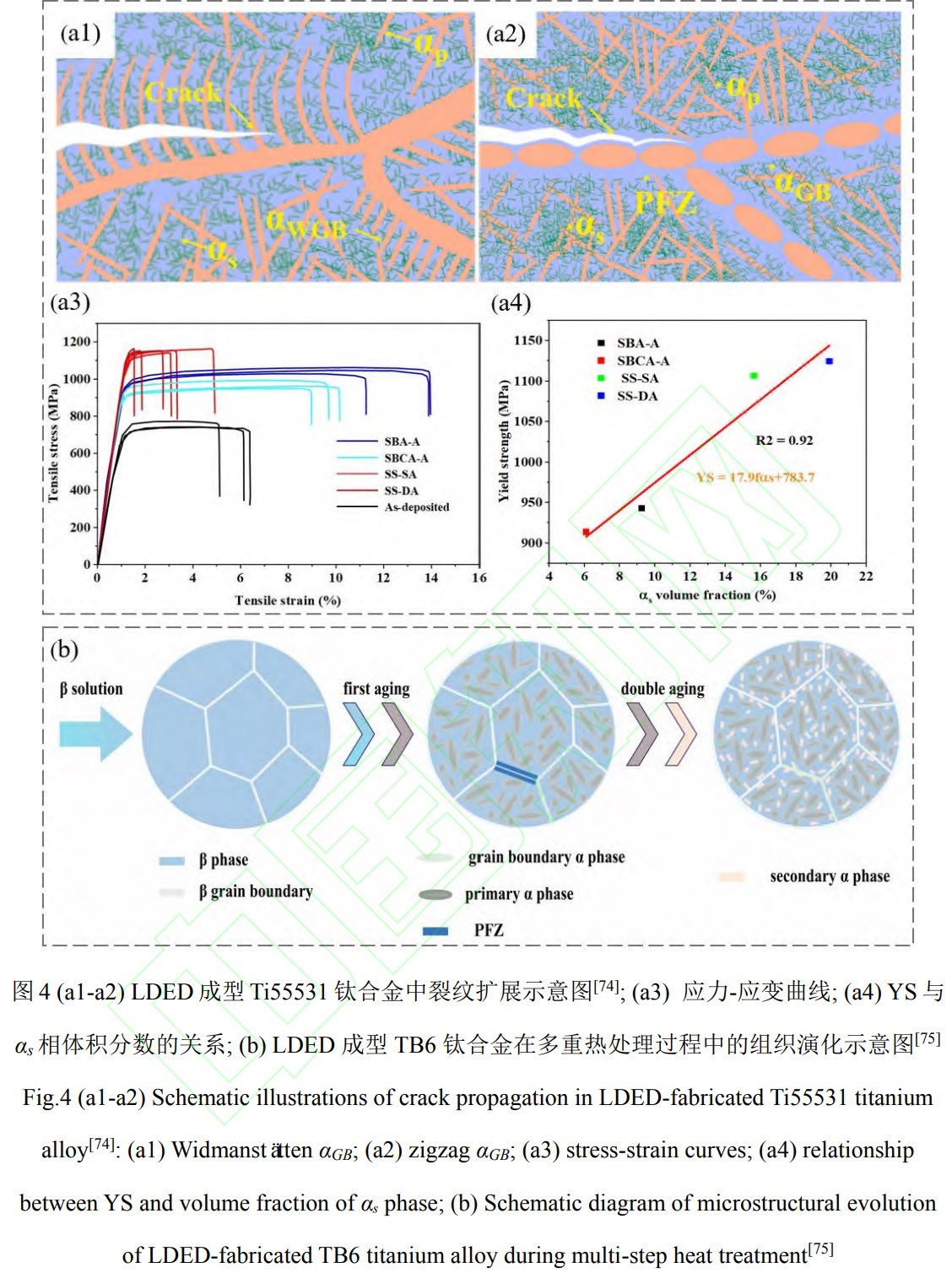
表1不同熱處理對(duì)LDED成型鈦合金組織和力學(xué)性能的影響[73-75]
| Titanium | Heat treatment | Microstructure | UTS | YS | EL | Ref. |
| alloy | process | /MPa | /MPa | (%) | ||
| TC4 | 600℃/4 h/AC | coarsening of the α p , continuous aGB | 965±9 | 898±9 | 13.4±2.7 | [73] |
| 800℃/1 h/AC | coarsening of the ap, continuous aGB, fine as | 950±4 | 869±5 | 26.8±3.3 | ||
| 975℃/1h/AC+600℃/4h/AC | equiaxed a phase, lamellar a phase | 904±5 | 822±4 | 14.2±1.3 | ||
| Ti55531 | SBA-A | Widmanst atten aGB | 1045+12 | 943±10 | 12.0±1.2 | [74] |
| SBCA-A | zigzag aGB | 969±18 | 914±13 | 8.6±0.4 | ||
| TB6 | 840℃ | β phase | 846 | 783 | 23.2 | [75] |
| 840℃+760℃ | Primary a,p phase, PFZ | 896 | 820 | 20.6 | ||
| 840℃+760℃+500℃ | fine acicular as phase | 1257 | 1109 | 4.0 | ||
| 840℃+760℃+530℃ | fine acicular as phase | 1180 | 1034 | 5.5 |
2.2 SLM成型鈦合金顯微組織及力學(xué)性能研究
2.2.1工藝參數(shù)對(duì)SLM成型鈦合金顯微組織及力學(xué)性能影響
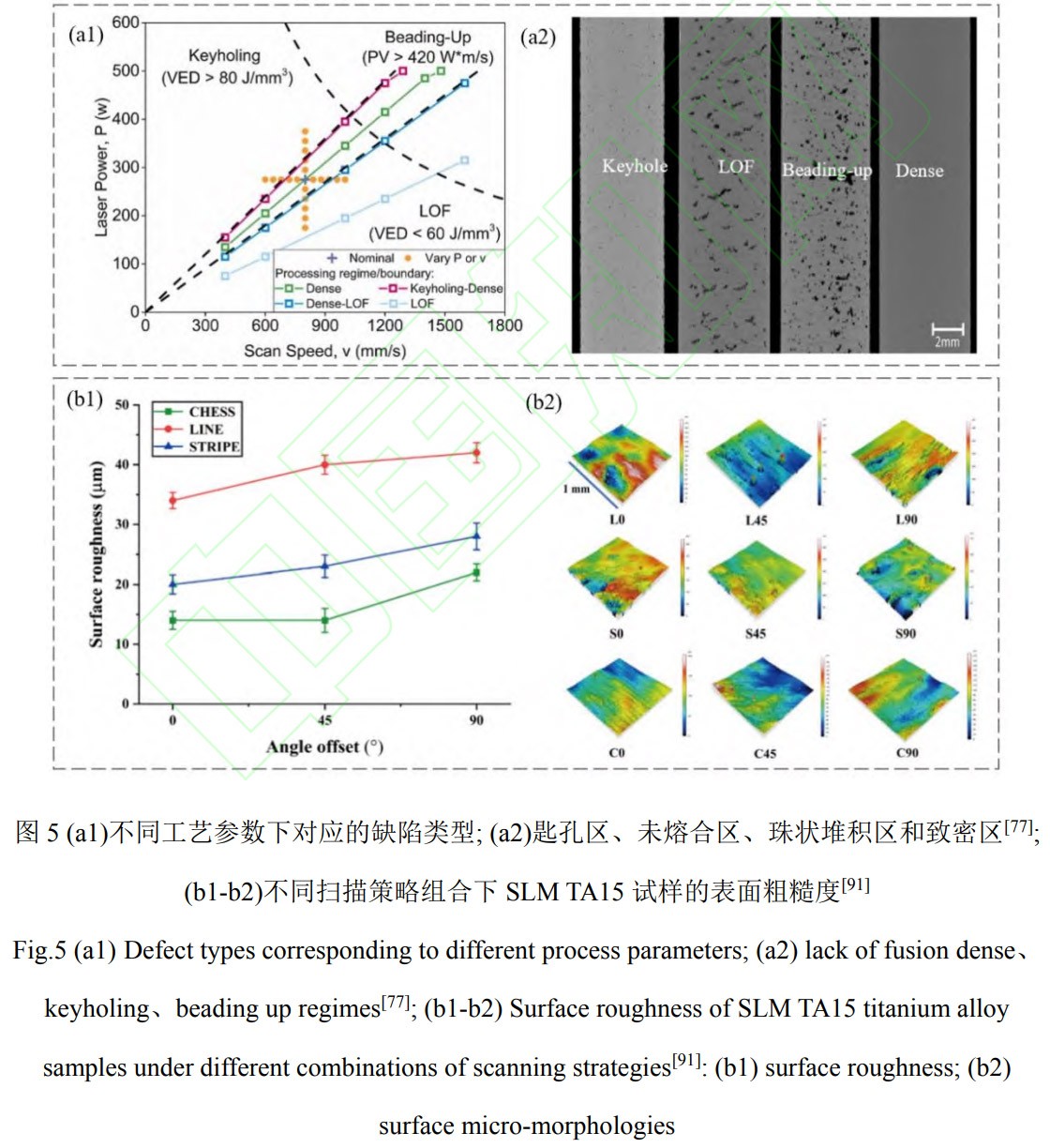
SLM成形質(zhì)量的核心在于工藝參數(shù)匹配與能量輸入控制,不當(dāng)?shù)膮?shù)組合易引發(fā)匙孔、未熔合孔洞等微觀缺陷[76-78]。能量密度(Energy Density, E)作為關(guān)鍵調(diào)控指標(biāo)可實(shí)現(xiàn)成形質(zhì)量的精準(zhǔn)控制[79, 80](E=P/(vht),P為激光功率,v為掃描速度,h為掃描間距,t為層厚)。P和v的協(xié)同優(yōu)化是控制E的核心,Zhang等[81]研究了P、v對(duì)SLM成型Ti-24Nb-4Zr-8Sn鈦合金構(gòu)件成形質(zhì)量的影響,通過(guò)優(yōu)化P、v值可實(shí)現(xiàn)致密度的提升。Cai等[82]研究了E對(duì)SLM成型TA15鈦合金顯微組織演變的影響:低E導(dǎo)致熔化不充分并產(chǎn)生氣孔,高E引發(fā)過(guò)熔與球化效應(yīng),此結(jié)論與Liverani等[83]、Wei等[84]和Guan等[85]研究一致。PANWISAWAS等[86]和QIU等[87]研究t對(duì)合金表面質(zhì)量的影響,較低的t利于合金表面的成形質(zhì)量,當(dāng)t超過(guò)0.04mm時(shí)使得表面粗糙度和孔隙率增大,繼續(xù)增加t將惡化合金的成形質(zhì)量。
此外,掃描策略可通過(guò)調(diào)整激光掃描路徑與方向,改變熱流傳遞路徑與熱量分布狀態(tài),調(diào)控晶粒取向與溫度梯度,緩解熱收縮不均帶來(lái)的應(yīng)力集中來(lái)降低殘余應(yīng)力[88,89]。陳德寧[90]對(duì)比島式與蛇形掃描發(fā)現(xiàn),島式掃描因島嶼邊緣二次升溫使TC4合金的溫度場(chǎng)分布更均勻,可減小應(yīng)力集中,但溫度梯度較低導(dǎo)致柱狀晶更粗大;Ali等[67]證實(shí),棋盤格掃描策略與連續(xù)層間旋轉(zhuǎn)角度有助于降低殘余應(yīng)力;Shi等[91]將直線LINE、棋盤格CHESS、條紋STRIPE掃描與定向角度偏移(0°、45°、90°)組合,發(fā)現(xiàn)CHESS&45°策略下,TC4合金試樣熔道連續(xù),無(wú)明顯孔洞,β相與α'相分布均勻;縱向截面可見沿成形方向排列的柱狀β晶,試樣表面粗糙度達(dá)14μm(如圖5(b1-b2)),致密度達(dá)99.85%。
2.2.2熱處理對(duì)SLM成型鈦合金顯微組織及力學(xué)性能影響
SLM成型鈦合金過(guò)程中,激光高能束高頻短時(shí)作用于鈦合金,使其在凝固過(guò)程中發(fā)生晶粒外延生長(zhǎng)導(dǎo)致柱狀晶的生成 [92, 93],最終使成型件呈現(xiàn)力學(xué)性能各向異性。受快速冷卻過(guò)程的影響,β相來(lái)不及轉(zhuǎn)化為α相從而在柱狀晶內(nèi)部形成了大量α'相使得鈦合金強(qiáng)度提升,但塑韌性降低 [94]。為了獲得優(yōu)異力學(xué)性能的鈦合金,Carrozza等[95]對(duì) SLM成型的 Ti6246合金進(jìn)行750℃/2h固溶處理后,α'相分解為片層狀α+β,實(shí)現(xiàn)強(qiáng)塑性的良好平衡。Huang等[96]對(duì)SLM成型TC4鈦合金進(jìn)行不同退火處理發(fā)現(xiàn)試樣的UTS和硬度均有所下降,而塑性有所提高。雙重退火制度可顯著消除晶界,柱狀晶粒消失后的組織尺寸分布趨于均勻,這有利于提高合金的塑性同時(shí)使得力學(xué)性能的各向異性顯著降低,其中在850℃/30 min/AC+600℃/2h/AC退火處理下力學(xué)性能各向異性改善效果最佳(詳見表2)。
與傳統(tǒng)的熱處理工藝相比,多步熱處理技術(shù)(Multi-Step Heat Treatment,MSHT)能有效促進(jìn)a球化與等軸組織形成,強(qiáng)度塑性匹配效果更顯著。Li等[97]對(duì)SLM成型TC4合金施加MSHT(工藝路線如圖6(a1),球化機(jī)制如圖6(a2)),通過(guò)逐步升溫保溫與爐冷,先使 α'完全分解為 α+β,再經(jīng)cylinderization、edge spheroidization等球化機(jī)制將片狀 α轉(zhuǎn)為近等軸α晶粒;該組織可降低力學(xué)各向異性與晶界滑動(dòng)阻力,實(shí)現(xiàn)強(qiáng)塑性匹配。Wang等[98]對(duì)TA15合金進(jìn)行低溫-高溫(Low-High Temperature,LHT)多步加熱后(工藝路線如圖6(b1)),形成片晶、等軸晶與短棒狀a組成的三態(tài)組織(形成機(jī)制如圖6(b2)),片狀a晶粒保證了合金的強(qiáng)度,等軸和短棒狀a晶粒降低晶界滑動(dòng)阻力、激活多滑移系提升塑性。
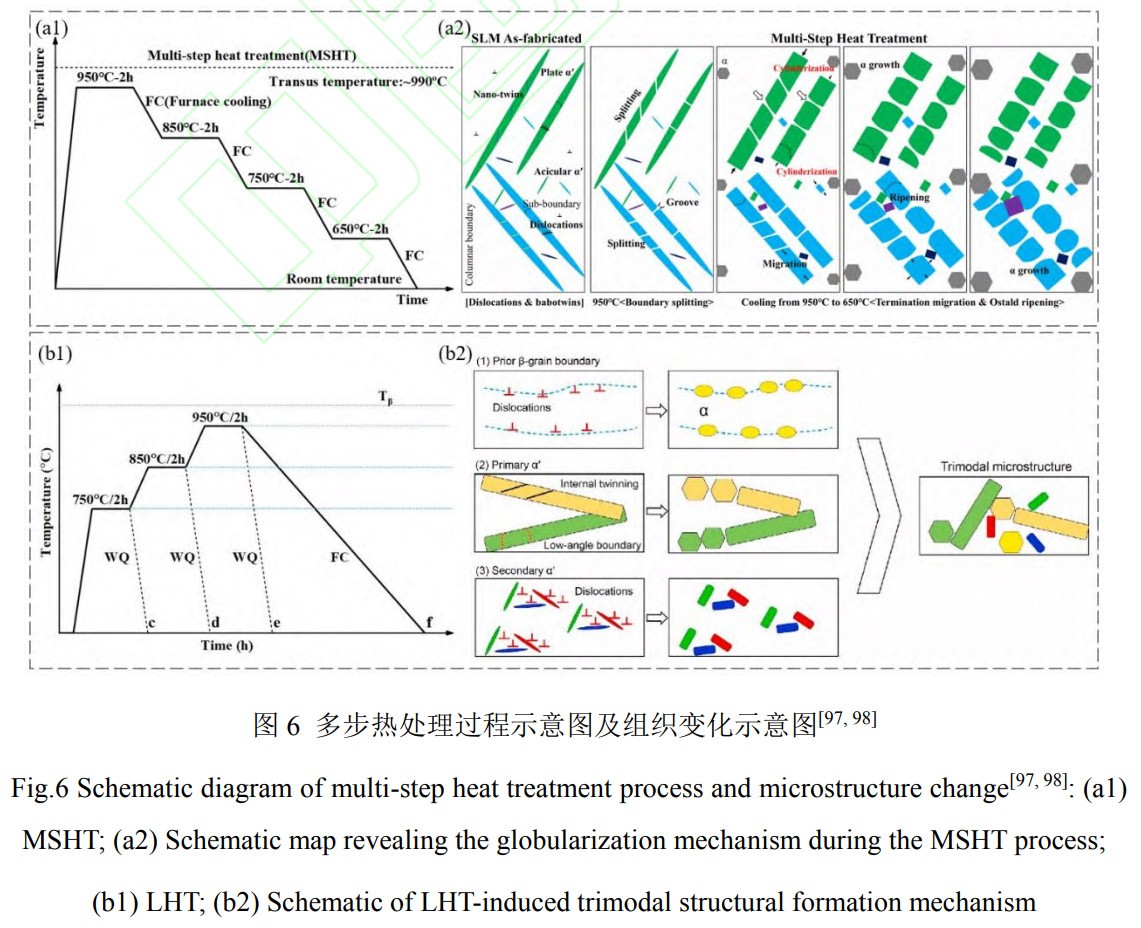
表 2不同熱處理對(duì) SLM成型鈦合金組織和力學(xué)性能的影響 [95−98]
| Titanium | Heat treatment | Microstructure | UTS | YS | EL | Ref. |
| alloy | process | /MPa | /MPa | (%) | ||
| Ti6246 | 750°C/2h | α ′ → α + β | 1146±41 | 1064±10 | 16.4±0.5 | [95] |
| TC4 | 850°C/30min/AC | columnar grain refinement, Widmanstatten | 900±20(X-Y) | 900±20(X-Y) | 11.5(X-Y) | [96] |
| 900℃/30min/AC | gradual melting of columnar grains, striated a/β phase | 850±10(X-Y) | 14.2(X-Y) | |||
| 950°C/30min/AC | disappearance of columnar grains, Basketweave, a phase coarsening | 700±8(X-Y) | 13.9(X-Y) | |||
| 850°C/30min/AC+600℃/2h/AC | short rod-like a phase, Striated a/β phase | 896(X-Y) | 13.2(X-Y) | |||
| TC4 | MSHT | α ′ → α + β, equiaxed | 953 | 900 | 21.8 | [97] |
| TA15 | LHT | αphase, short rod-like a phase | 1033±4 | 967±4 | 16.6±0.5 | [98] |
2.3 WAAM成型鈦合金顯微組織及力學(xué)性能研究
2.3.1工藝參數(shù)對(duì)WAAM成型鈦合金顯微組織及力學(xué)性能的影響
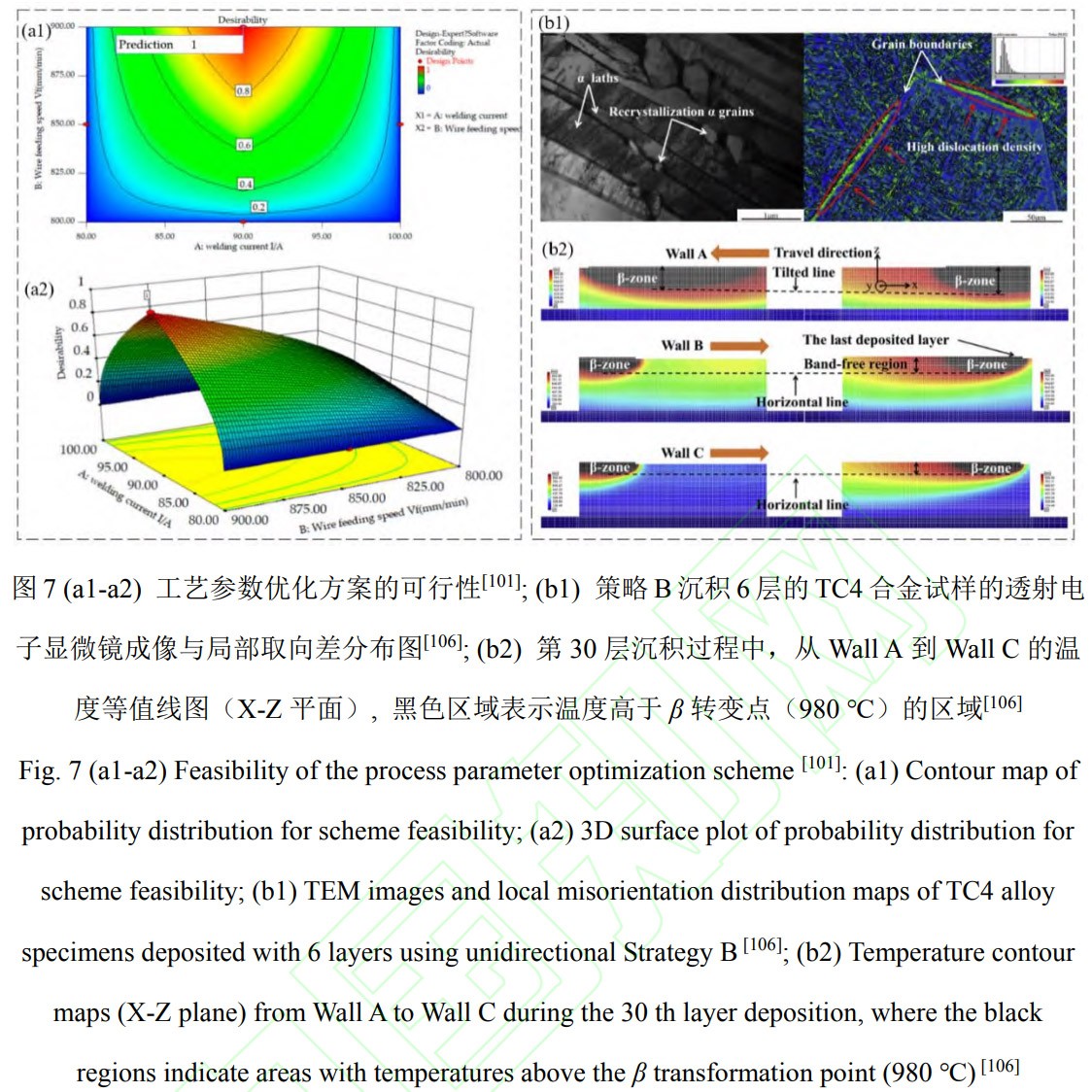
WAAM成型過(guò)程中焊道形貌可直觀反映焊接質(zhì)量[99],孫清潔等[100]研究表明,調(diào)整電弧電流可有效調(diào)節(jié)Ti60合金焊道的宏觀成形,增大熔寬和熔深,減少金屬球化并提升焊道均勻性。Liu等[101]針對(duì)GTAM-WAAM成型TC4合金,采用Box-Behnken設(shè)計(jì)響應(yīng)面實(shí)驗(yàn)構(gòu)建熔覆層寬、高及熔深的回歸模型,方差分析表明:焊接電流(I)、送絲速度(V)與焊槍移動(dòng)速度(Vs)為關(guān)鍵影響因子。其可行性指標(biāo)分布如圖7(a1-a2)所示,最優(yōu)參數(shù)對(duì)應(yīng)圖中紅色區(qū)域;最優(yōu)參數(shù)下,TC4薄壁件韃課瘓鶴櫓琣相從頂部到底部逐漸粗化,顯微硬度隨之下降,拉伸性能因a相排列及晶粒取向呈現(xiàn)各向異性。
熱輸入過(guò)高會(huì)導(dǎo)致沉積層間溫度升高、層高減小、寬度增大,引發(fā)尾部塌陷,影響成形質(zhì)量與力學(xué)性能[102,103]。通過(guò)層間強(qiáng)制冷卻和合理的路徑規(guī)劃能夠使熱輸入均勻分布,減少局部過(guò)熱或冷卻過(guò)快引發(fā)的缺陷,細(xì)化晶粒促進(jìn)等軸晶的生成,提升材料性能。如,Ogino等[104]發(fā)現(xiàn),每道次成型后冷卻并嚴(yán)格控制層間溫度,可明顯改善尾部塌陷;He等[105]通過(guò)梯度熱輸入結(jié)合層間冷卻工藝,通過(guò)提高冷卻速率抑制柱狀晶粒外延生長(zhǎng),使Ti-6Al-2Zr-1Mo-1V(TC11)合金形成細(xì)柱狀-等軸混合組織,其顯微硬度、UTS和EL分別提高了5.3%、6.6%和37.6%。Wang等[106]對(duì)比分析了三種沉積策略(A:雙向掃描+0s層間停留,B:單向掃描+24s層間停留,C:單向掃描+120s層間停留)對(duì)WAAM成型TC4合金的溫度與應(yīng)力應(yīng)變場(chǎng)的影響:在策略B下,a片層邊界形成無(wú)位錯(cuò)再結(jié)晶a晶粒,位錯(cuò)向先 β晶界富集,晶粒內(nèi)部呈低儲(chǔ)能狀態(tài)(如圖7(b1));單向掃描路徑使熱場(chǎng)分布均勻并形成水平層帶(圖7(b2));策略C更長(zhǎng)的停留時(shí)間為已沉積層提供了更充足的散熱時(shí)間,使得沉積過(guò)程中的熱積累顯著降低,且熱場(chǎng)分布更均勻,α片層寬度變化平緩,最終獲得等軸晶組織,顯著提材料強(qiáng)度和硬度。
2.3.2熱處理對(duì)WAAM成型鈦合金顯微組織及力學(xué)性能的影響
WAAM在逐層堆積的過(guò)程中使材料經(jīng)歷多次的熱循環(huán),同時(shí)材料在凝固過(guò)程中的冷卻速度較大,使得原始柱狀 β相會(huì)轉(zhuǎn)變成不同形態(tài)的脆性 α相,造成合金強(qiáng)度和塑性等力學(xué)性能的各向異性 [107]。為了改善微觀組織均勻性和材料力學(xué)性能的各向異性,研究人員對(duì)WAAM成型鈦合金熱處理工藝進(jìn)行了深入研究。張帥鋒等[108]在 CMT-WAAM成型Ti-6Al-3Nb-2Zr-1Mo(Ti6321)合金過(guò)程中發(fā)現(xiàn),經(jīng)700℃退火后,Ti6321合金UTS下降70 MPa,這是由于熱處理導(dǎo)致位錯(cuò)密度降低,位錯(cuò)間的交互作用減弱,從而減少了對(duì)位錯(cuò)滑移的阻礙作用。當(dāng)退火溫度升高至800℃時(shí),α片層進(jìn)一步均勻化,其相鄰片層間的亞穩(wěn) β相進(jìn)一步轉(zhuǎn)變分解,亞穩(wěn) β相轉(zhuǎn)變?yōu)槎贪魻?α相, α/ β相界面數(shù)量增加,從而增強(qiáng)了對(duì)滑移的阻礙效果,促使強(qiáng)度升高。Lin等 [109]采用Gleeble熱模擬構(gòu)建了 WAAM成型 TC4合金不同熱處理態(tài)(沉積態(tài):AD;固溶態(tài):AD-ST;固溶+時(shí)效態(tài):AD-ST-Age)的微觀結(jié)構(gòu)梯度,AD-ST-Age態(tài)α相取向集中性高于AD-ST態(tài)(圖8(a1-a2)),最優(yōu)的熱處理工藝為AD-ST-Age(830 ∘C/2h/WC+ 500 ∘C/4 h/FC,F(xiàn)C:爐冷),ST使 α ′馬氏體的細(xì)化,Age促進(jìn) α魏氏體的細(xì)化及 α'分解,最終使YS、UTS分別提高12.85%、3.33%。Wang等[110]對(duì)WAAM成型TC4合金采用了五種不同的熱處理方案(HT1-HT5)研究其微觀結(jié)構(gòu)演變,與沉積態(tài)相比,經(jīng)過(guò)HT1處理后,α/β界面相部分分解,導(dǎo)致了EL的降低;HT2處理后板條 α相粗化,并且在HT2試樣中觀察到了有利于提高塑性的 α/β界面相,導(dǎo)致了UTS的降低和EL的增加。而經(jīng)HT5處理后,出現(xiàn)細(xì)小的不連續(xù) α GB 相、 α p 相和αs相,αs相起到較強(qiáng)的彌散強(qiáng)化作用,β相中V元素的界面偏析獲得了較多的α/β相界面(圖8(b1-b2)),且細(xì)小不連續(xù)的 α GB 相避免了應(yīng)力集中,使試樣的UTS和EL分別達(dá)到886 MPa和 16.6%(詳見表3)。
綜上所述,WAAM熱輸入顯著影響鈦合金成形質(zhì)量,均勻化熱輸入是改善組織形態(tài)、提升力學(xué)性能的重要技術(shù)路徑。鈦合金的強(qiáng)度源于a相細(xì)化、彌散強(qiáng)化及位錯(cuò)阻礙作用,塑性主要依賴 α/β相界面的變形協(xié)調(diào)能力。通過(guò)退火、固溶+時(shí)效等熱處理工藝可進(jìn)一步調(diào)控組織形態(tài),包括a相、亞穩(wěn)相及a/β相界面數(shù)量,實(shí)現(xiàn)強(qiáng)塑性的均衡提升。
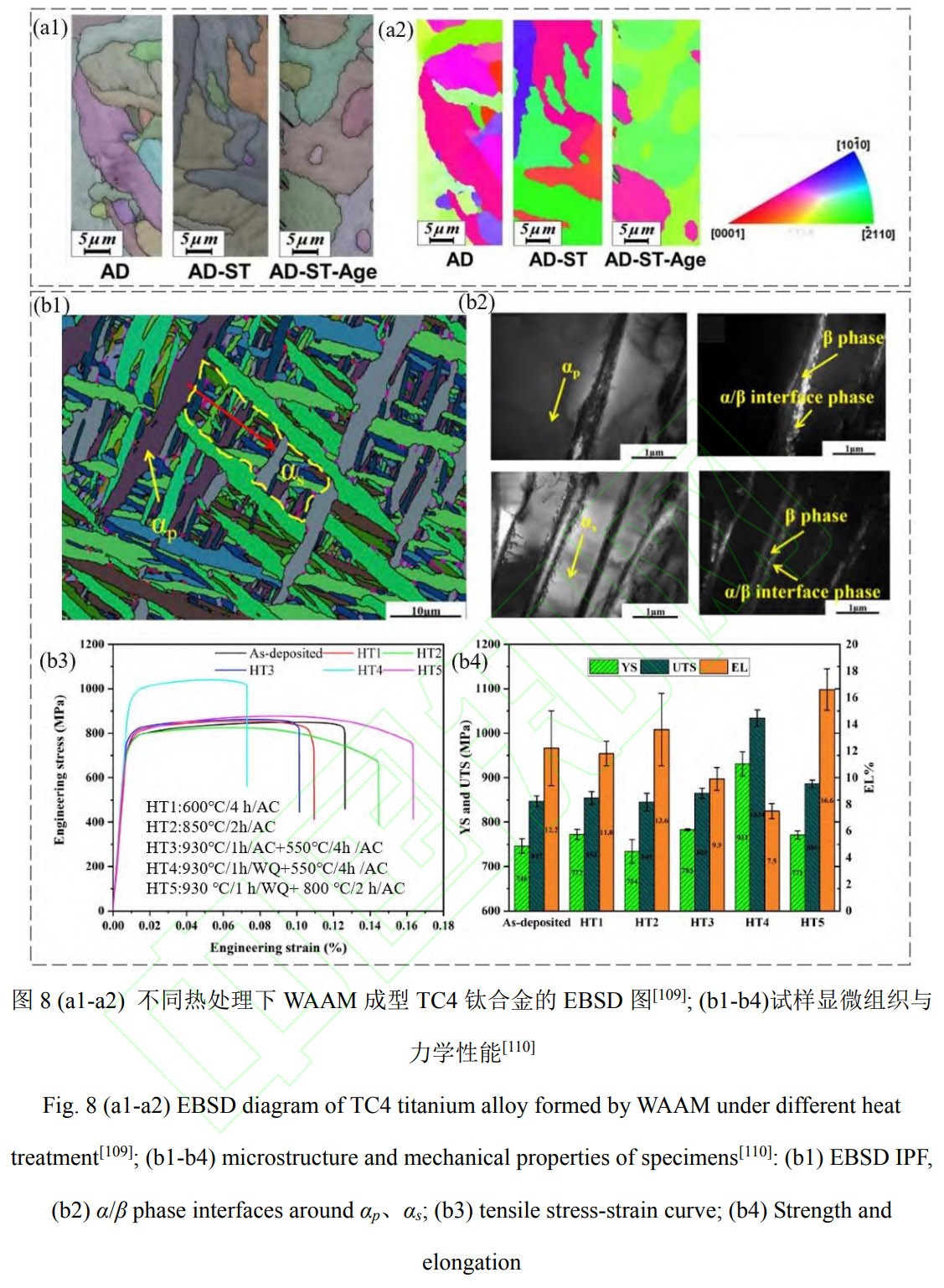
表3不同熱處理對(duì)WAAM成型鈦合金組織和力學(xué)性能的影響[108-110]
| Titanium alloy | Heat treatment process | Microstructure | UTS /MPa | YS /MPa | EL (%) | Ref. |
| Ti6321 | 700℃退火2h | the dislocation density inside the a lamellae decreases | 1100 | 900 | 15 | [108] |
| 800℃退火2h | homogenization of a lamellae, decomposition of βphase | 1100 | 1000 | 12 | ||
| TC4 | 830°C/2h/WC | metastable a' martensite | 925.3 | 925.3 | 9 | [109] |
| 830°C/2h/WC+500°C/4h/AC | fine acicular secondary as phase, short rod-like aGB | 954.38 | 871.31 | 5.37 | ||
| 830°C/2h/WC+800°C/2h/AC | Short rod-like secondary a phase | 904.33 | 811.72 | 8 | ||
| 830°C/2h/WC+500°C/4h/FC | fine acicular secondary as phase, granular aGB | 946.46 | 902.62 | 5.38 | ||
| TC4 | 600℃/4h/AC | partial decomposition of the a/β interfacial phase | 854 | 772 | 11.8 | [110] |
| 850°C/2h/AC | a phase lath coarsening, secondary as phase | 845 | 734 | 13.6 | ||
| 930°C/1h/AC+550°C/4h/AC | a, a, residualβ phase | 865 | 783 | 9.9 |
2.4復(fù)合能量場(chǎng)成型鈦合金顯微組織及力學(xué)性能研究
隨著航空航天、生物醫(yī)學(xué)等高端領(lǐng)域?qū)?gòu)件結(jié)構(gòu)穩(wěn)定性、性能可靠性及輕量化需求不斷提升,傳統(tǒng)單一調(diào)控手段已難以滿足復(fù)雜工況要求,外場(chǎng)輔助調(diào)控技術(shù)(AF、DF、MF等)被引入以優(yōu)化鈦合金的成形質(zhì)量并提升其力學(xué)性能[111]。
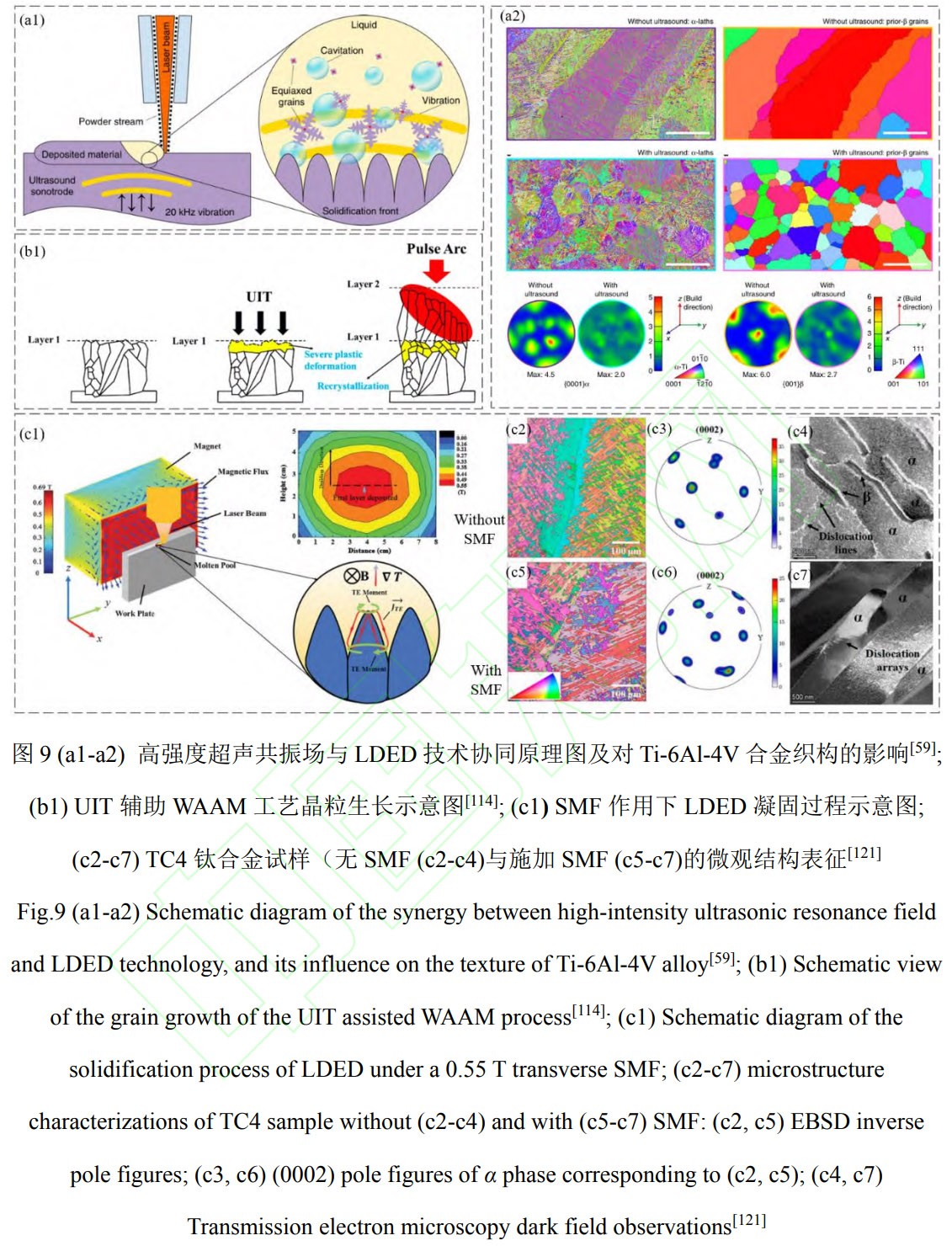
AF輔助通常是利用UV產(chǎn)生的聲能與AM相結(jié)合,利用其獨(dú)特的聲流與空化效應(yīng)來(lái)控制金屬熔池的凝固過(guò)程[59,112,113]。Todaro等[59]將高強(qiáng)度超聲共振場(chǎng)與LDED技術(shù)協(xié)同(圖9(a1)),通過(guò)UV引發(fā)的熔池?cái)_動(dòng)與晶粒破碎,將TC4合金中粗大的柱狀β晶細(xì)化為等軸晶,電子背散射衍射(Electron Backscatter Diffraction,EBSD)(圖9(a2))表明,無(wú)超聲時(shí),α相、β相均呈現(xiàn)明顯擇優(yōu)取向;施加超聲使a相、β相的最大均勻分布倍數(shù)(Multiples of Uniform Distribution,MUD)減小,織構(gòu)弱化, β相轉(zhuǎn)為等軸晶粒且<001>織構(gòu)消失,各向異性降低,UTS、YS較未處理態(tài)提高約12%。
在AM過(guò)程中引入DF使沉積層發(fā)生塑性變形,在下一層沉積時(shí),塑性變形部分可能發(fā)生再結(jié)晶,從而改變材料微觀組織與力學(xué)性能。Yang等[114]采用UIT輔助WAAM工藝,在Ti-6Al-4V沉積后實(shí)施兩次UIT,使粗大柱狀β晶轉(zhuǎn)變?yōu)榈容S晶與短柱狀晶交替分布的組織,提升表層均勻性(圖9(b1)UIT輔助WAAM工藝晶粒生長(zhǎng)示意圖)。Chen等[115]采用UIT輔助LDED制備TA15鈦合金,晶粒細(xì)化使UTS和EL均提高。此外,DF還能將沉積表面一定深度范圍內(nèi)殘余拉應(yīng)力被轉(zhuǎn)變?yōu)閷?duì)材料力學(xué)性能有益的壓應(yīng)力[116],孟憲凱團(tuán)隊(duì)[117]研究發(fā)現(xiàn),LSP在TC6合金表層引入殘余壓應(yīng)力,抑制疲勞裂紋的萌生與擴(kuò)展,延長(zhǎng)疲勞壽命;其開發(fā)的雙脈沖LSP技術(shù),通過(guò)延長(zhǎng)沖擊作用時(shí)間,誘導(dǎo)Ti6Al4V合金形成“細(xì)晶-粗晶-細(xì)晶”的復(fù)合結(jié)構(gòu),顯著提升顯微硬度與強(qiáng)度,且保持良好的塑性。
MF定向調(diào)控中,縱向與橫向MF作用機(jī)制存在差異。縱向MF通過(guò)洛倫茲力驅(qū)動(dòng)熔池環(huán)向流動(dòng),可增加焊道寬高比、降低表面粗糙度,并抑制邊緣焊道流淌與塌陷[118,119];橫向MF則通過(guò)偏轉(zhuǎn)電弧誘導(dǎo)熔池單向?qū)α鳎档腿鄢氐撞康容S晶區(qū)域的占比與胞狀枝晶間距,提升枝晶前沿成分過(guò)冷度[120]。Zhao等[121]將磁場(chǎng)與LDED相結(jié)合(如圖9(c1)所示),研究發(fā)現(xiàn),在0.55T橫向靜磁場(chǎng)(Static Magnetic Field,SMF)下制備TC4鈦合金的性能最優(yōu),SMF通過(guò)調(diào)控熔池流動(dòng)與固態(tài)相變,增強(qiáng)a相晶界連續(xù)性(圖9(c5))、分散取向;弱化β晶粒織構(gòu)(圖9(c3,c6)),增加α相形核數(shù)量并形成規(guī)則位錯(cuò)陣列與亞晶界(圖9(c7)),有效降低力學(xué)性能各向異性;該團(tuán)隊(duì)[122]進(jìn)一步提出高磁場(chǎng)(High Magnetic Field, HMF, 3T)與熱處理相結(jié)合調(diào)控SLM成型TC4合金的組織,發(fā)現(xiàn)HMF可加速a相的粗化和球化,雖使UTS與YS相較原始態(tài)略有降低,但EL提高至14.1%-15.4%,實(shí)現(xiàn)更優(yōu)的強(qiáng)塑性匹配。
綜上所述,外場(chǎng)輔助技術(shù)通過(guò)調(diào)控AM鈦合金微觀組織特征,如改善織構(gòu)強(qiáng)度、誘導(dǎo)柱狀晶向等軸晶轉(zhuǎn)變、引入殘余壓應(yīng)力等方面,實(shí)現(xiàn)強(qiáng)度與塑性的同步提升,然而,當(dāng)前關(guān)于外場(chǎng)輔助與熱處理工藝耦合的系統(tǒng)性研究較為匱乏,其作用機(jī)制與工藝適配性的深入探索具有重要的理論與工程價(jià)值。
2.5有限元仿真模擬鈦合金增材制造過(guò)程
有限元分析(Finite Element Analysis,F(xiàn)EA)通過(guò)構(gòu)建多物理場(chǎng)耦合模型,可精準(zhǔn)模擬從熔池演變到逐層堆積的全過(guò)程,量化工藝參數(shù)對(duì)應(yīng)力、變形及微觀組織的影響,已成為預(yù)測(cè)并優(yōu)化金屬AM質(zhì)量的主流數(shù)值方法。該方法彌補(bǔ)了實(shí)驗(yàn)手段在瞬態(tài)場(chǎng)監(jiān)測(cè)方面的局限,支持參數(shù)化仿真與快速工藝評(píng)估,為L(zhǎng)DED、SLM、WAAM等工藝的成型控制提供了重要理論依據(jù)。
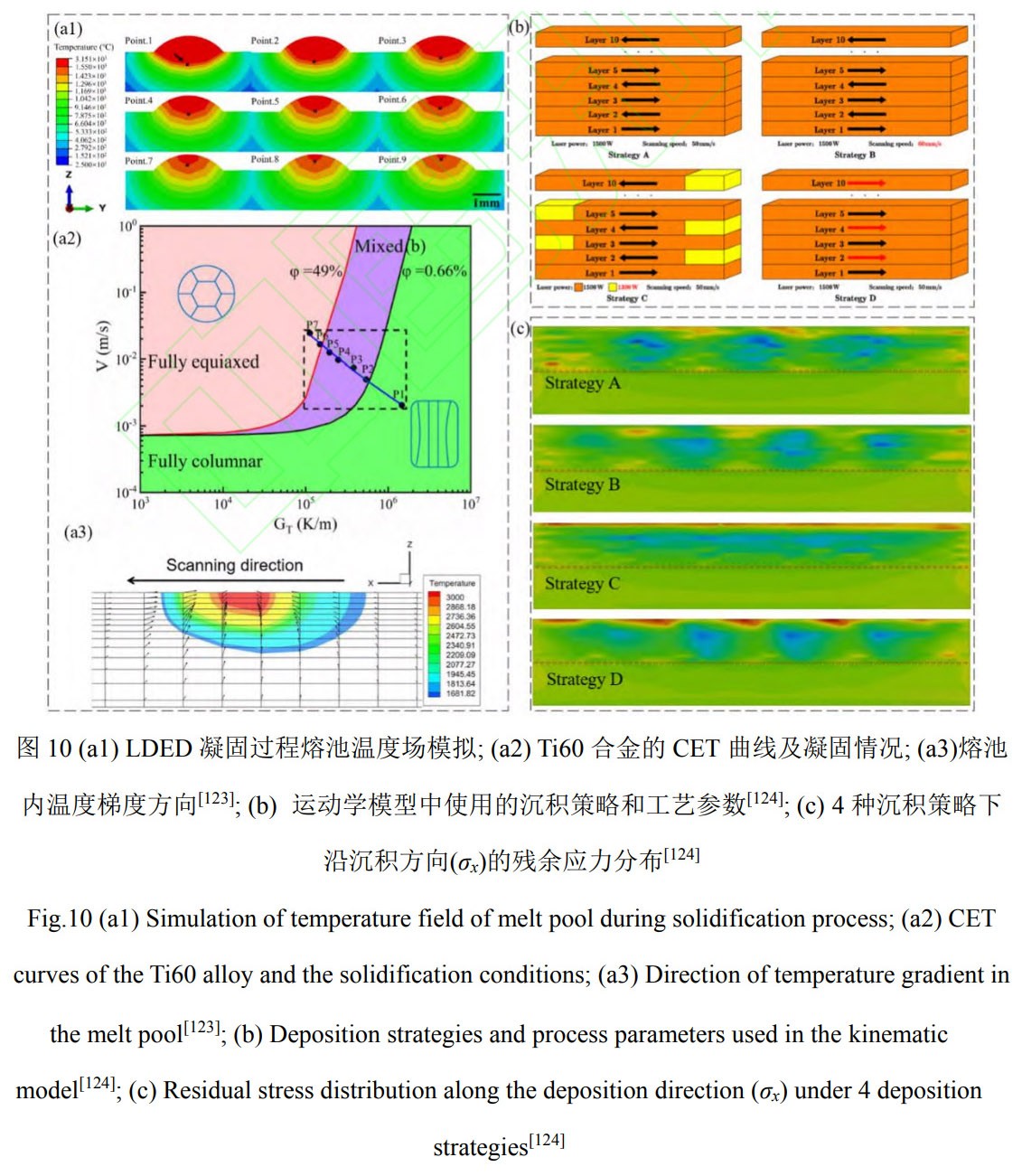
在LDED工藝中,循環(huán)熱載荷導(dǎo)致工件劇烈的溫度波動(dòng),冷卻后形成殘余拉應(yīng)力。Deng等[123]建立了三維瞬態(tài)熱分析有限元模型,模擬Ti60鈦合金在LDED成型過(guò)程中的熔池演化(如圖10(a1)),通過(guò)G和V的關(guān)聯(lián)(圖10(a2))揭示了晶粒生長(zhǎng)模式對(duì)組織形態(tài)的影響,指出柱狀晶向等軸晶轉(zhuǎn)變(Columnar to Equiaxed Transition,CET))有助于緩解熱收縮不均,降低殘余應(yīng)力,如圖10(a3)所示,熔池內(nèi)溫度梯度方向的變化促使等軸晶多向生長(zhǎng),進(jìn)而弱化織構(gòu)。Wu等[124]針對(duì)LDED成型Ti6Al4V合金,構(gòu)建熱-力耦合有限元模型,提出可變激光功率沉積策略StrategyC(四種策略詳見圖10(b)),動(dòng)態(tài)模擬溫度與應(yīng)力場(chǎng)演變。結(jié)果表明:該策略使試樣平均基底溫度降低12.68%-15.08%,最大主應(yīng)力下降7.8%-32.14%;圖10(c)為四種沉積策略下沿沉積方向的殘余應(yīng)力(σx)分布情況,其中StrategyC通過(guò)降低溫度梯度,使殘余應(yīng)力分布更均勻,模擬與實(shí)驗(yàn)的溫度及應(yīng)力誤差分別控制在10.12%和6.92%以內(nèi)。
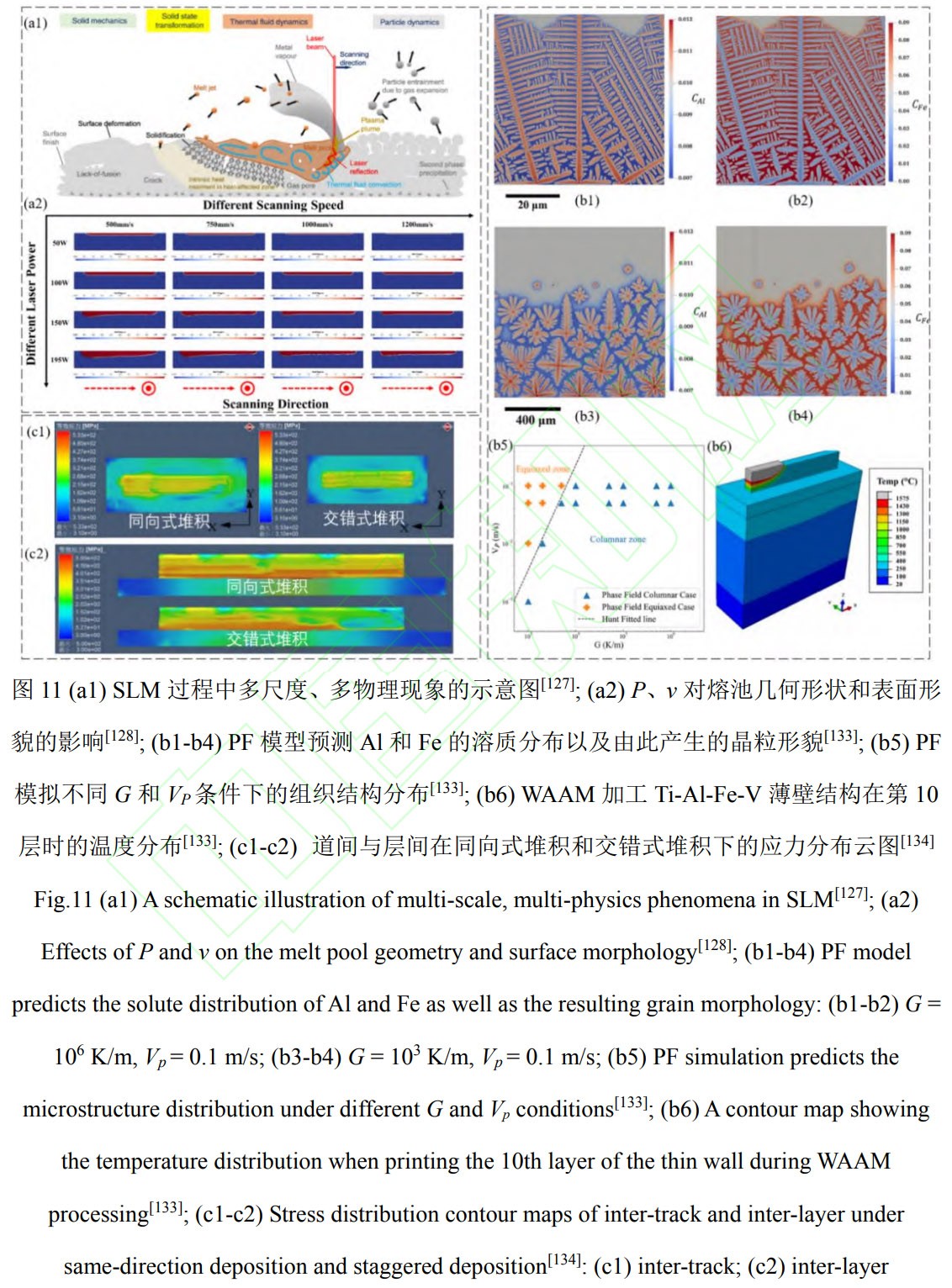
在SLM加工過(guò)程中,金屬粉末受到高能能量束瞬時(shí)輻照,熔化形成微尺度熔池,隨著能量熱源移動(dòng),熔池在先前沉積的基底冷卻作用下迅速凝固,使熔池內(nèi)部表現(xiàn)出高溫度梯度(G)(>10^2 K/mm)、高冷卻速率(V)(約10^7 K/s)和高殘余熱應(yīng)力累積的非平衡短時(shí)冶金特征[125]。這種極端加工條件和復(fù)雜流體動(dòng)力學(xué)行為的耦合作用,極易產(chǎn)生氣孔、匙孔孔隙、熔合不良、球化效應(yīng)等缺陷[126]。為深入揭示工藝對(duì)缺陷形成的影響機(jī)制并實(shí)現(xiàn)精準(zhǔn)調(diào)控,介觀尺度數(shù)值模擬已成為重要研究手段,圖11(a1)為SLM制造中多尺度、多物理場(chǎng)現(xiàn)象的示意圖[127]。鐘敏奎[128]通過(guò)多物理場(chǎng)模擬與實(shí)驗(yàn)相結(jié)合的方法,系統(tǒng)分析了P、v對(duì)SLM成型TC4鈦合金熔池尺寸的影響(如圖11(a2)所示):隨著P增加,熔池寬度與深度均相應(yīng)擴(kuò)大;隨著v的減小,熱積累效應(yīng)增強(qiáng),熔池尺寸顯著增大,證實(shí)了P、v的協(xié)同調(diào)控是優(yōu)化熔池形貌、抑制缺陷的關(guān)鍵途徑。Yin等[129]對(duì)SLM成型TC4合金的溫度場(chǎng)進(jìn)行有限元仿真,發(fā)現(xiàn)提高v和優(yōu)化沉積高度可有效減少因晶粒取向差異導(dǎo)致的不均勻收縮,從而降低殘余應(yīng)力與變形。在掃描策略與輔助工藝優(yōu)化方面,Cheng等[130]研究表明,SLM成型過(guò)程中X、Y方向的應(yīng)力集中主要分布于沉積層邊緣及基體界面區(qū)域,其中環(huán)形掃描模式下應(yīng)力值最大,而45°斜線掃描可通過(guò)均勻化溫度場(chǎng)分布,顯著降低兩個(gè)方向的殘余應(yīng)力。此外Zhou等[131]利用激光重熔(Laser Remelting,LR)多場(chǎng)耦合模型研究了LR對(duì)致密度、氣孔等的調(diào)控,受成形過(guò)程預(yù)熱的影響,LR形成的熔池尺寸更大,有助于促進(jìn)熔體流動(dòng)與孔隙填充,從而實(shí)現(xiàn)致密度提升與缺陷消除。
WAAM的沉積過(guò)程往往伴隨著較大的熱輸入和局部熱積累,導(dǎo)致殘余應(yīng)力分布不均勻和變形,還會(huì)導(dǎo)致粗晶組織 [132]。Li等 [133]結(jié)合多組分相場(chǎng)(Phase Field,PF)模型與FEA,預(yù)測(cè)WAAM成型Ti-Al-Fe-V合金的CET行為,PF模擬表明低G和高V利于等軸晶形成(圖11(b1-b4);FEA進(jìn)一步獲取了瞬態(tài)G、V分布與溫度場(chǎng)(圖11(b5-b6)),揭示熱輸入密度對(duì)CET位置的關(guān)鍵影響:高能量輸入促使CET提前發(fā)生。劉國(guó)昌等[134]采用Simufact Welding軟件仿真激光電弧復(fù)合AM的熱力場(chǎng),并通過(guò)試驗(yàn)驗(yàn)證模型的可靠性,發(fā)現(xiàn)溫度積累效應(yīng)顯著,等效應(yīng)力逐步轉(zhuǎn)化為殘余應(yīng)力,且應(yīng)力集中于道間、層間結(jié)合區(qū)及基板連接處;基于仿真優(yōu)化,通過(guò)不同堆積路徑下應(yīng)力分布圖(圖11(c1-c2))得出道間堆積采用同向式(左至右)、層間堆積采用交錯(cuò)式的最優(yōu)路徑方案,有效改善了應(yīng)力分布與成形質(zhì)量。
綜上,F(xiàn)EA作為金屬AM質(zhì)量預(yù)測(cè)與工藝優(yōu)化的核心數(shù)值方法,通過(guò)構(gòu)建多物理場(chǎng)耦合模型,可精準(zhǔn)模擬LDED、SLM、WAAM等典型工藝的熔池演變、逐層堆積及瞬態(tài)場(chǎng)演化全過(guò)程,有效彌補(bǔ)了實(shí)驗(yàn)手段在瞬態(tài)監(jiān)測(cè)中的局限,為量化工藝參數(shù)對(duì)殘余應(yīng)力、變形及微觀組織的影響提供了重要理論支撐。
3、增材制造鈦合金的耐腐蝕性能研究
3.1激光增材制造鈦合金的耐腐蝕性
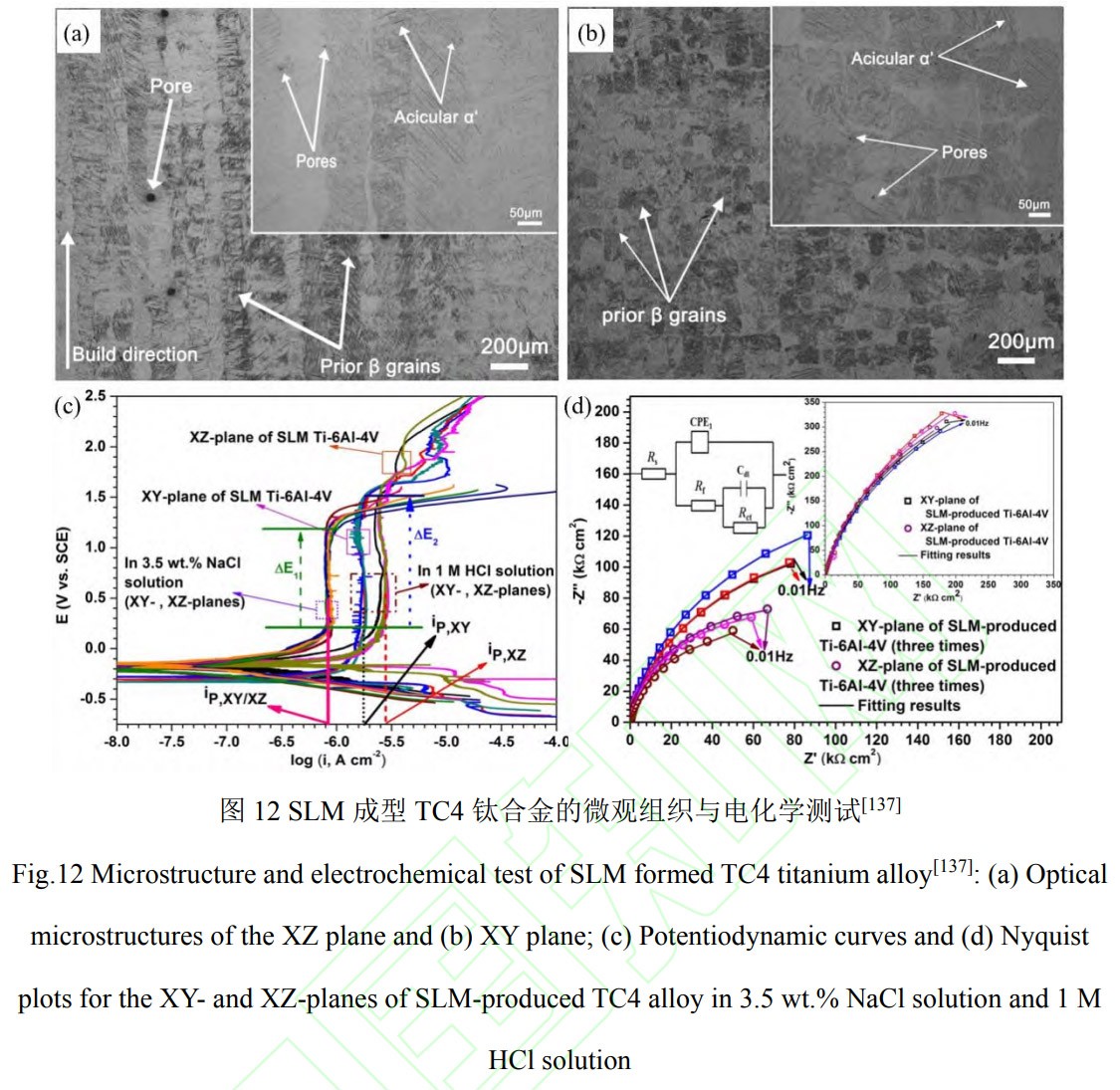
激光成型鈦合金的耐腐蝕性能與其顯微組織特征密切相關(guān)。較低的v有利于形成細(xì)小的 α ′馬氏體,從而提高表面鈍化膜的致密性與均勻性,顯著增強(qiáng)合金的耐腐蝕性能 [135]。Lu等[136]研究表明,在高P(250W)與中等v(1200mm/s)下成型的TC4合金具有優(yōu)良的綜合性能:其內(nèi)部為規(guī)則生長(zhǎng)的柱狀β晶與分散分布的針狀 α ′馬氏體,不僅力學(xué)性能優(yōu)異,且表面可快速形成以TiO2為主的致密鈍化膜,這是其耐腐蝕性能突出的關(guān)鍵因素。由于顯微組織的差異,SLM成型鈦合金的耐蝕性能是各向異性的。Dai等[137]通過(guò)電化學(xué)測(cè)試與組織分析比較了TC4合金XY與XZ平面的耐蝕行為。經(jīng)Tafel擬合結(jié)果(如圖12(a-b)所示),在3.5 wt% NaCl溶液中,兩平面的鈍化電流密度相近;而在1MHCl溶液中,XZ平面的鈍化電流密度高于XY平面,說(shuō)明XY平面的耐蝕性更優(yōu)。其原因在于XZ平面α相含量較高、 β相較少( β相是一種良好的腐蝕抑制劑),導(dǎo)致其耐蝕性較差(如圖12(c-d)所示)。退火與熱等靜壓(HotIsostatic Pressing,HIP)等熱處理也對(duì)耐腐蝕性能具有重要影響[92,138]。退火處理可使 α/β相分布更均勻,降低材料各向異性;HIP處理則能有效閉合SLM成型過(guò)程中形成的缺陷,顯著提高TC4合金在腐蝕介質(zhì)中的耐腐蝕性能。Li等[139]針對(duì) SLM成型Ti-6Al-4V-3Cu合金,研究了不同溫度(760°C、820°C、875C)保溫2h后水冷的組織演變及其對(duì)耐腐蝕性能的影響。結(jié)果表明:760℃熱處理為最優(yōu)工藝,可實(shí)現(xiàn) α ′馬氏體部分分解( α ′ → α + β)與殘余應(yīng)力釋放,同時(shí)避免晶粒粗化與Ti 2Cu相非均勻析出,所得致密穩(wěn)定的鈍化膜(以TiO2為主),耐腐蝕性能最佳。Anantharam等[140]發(fā)現(xiàn),經(jīng)800℃/2h退火處理的LDED成型Ti-6Al-4V合金腐蝕電流密度顯著降低,耐腐蝕性最優(yōu)。其原因?yàn)橥嘶鸫偈?alpha;'相轉(zhuǎn)變?yōu)閍+β相雙向組織,減少a/β界面面積,提升電化學(xué)穩(wěn)定性;未處理的沉積樣品由于缺乏β相,表現(xiàn)出更高的腐蝕傾向。
3.2電弧增材制造鈦合金的耐腐蝕性
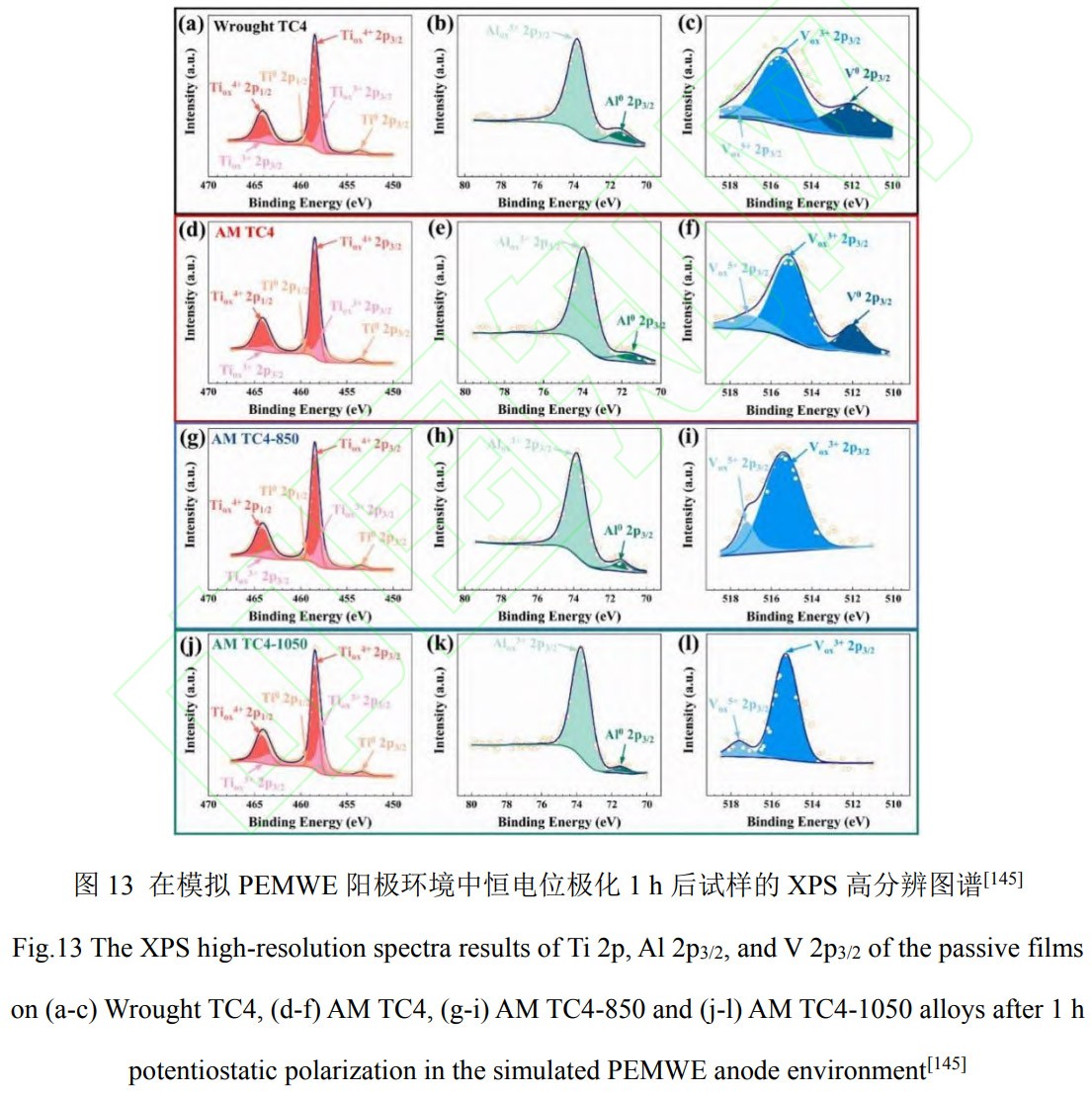
WAAM成型的鈦合金,其微觀結(jié)構(gòu)常呈現(xiàn)晶粒取向與 α/ α ′相形態(tài)的各向異性,導(dǎo)致耐腐蝕性能普遍低于傳統(tǒng)鍛件。研究表明,鈦合金的腐蝕行為強(qiáng)烈依賴于其微觀結(jié)構(gòu)和服役環(huán)境 [141]。熱處理是調(diào)控組織并影響耐蝕性能的關(guān)鍵手段,但其效果因合金成分與工藝條件而異。例如,在3.5wt%NaCl溶液和5MHCl溶液中,Ti-6Al-3Nb-2Zr-1Mo合金的耐腐蝕性會(huì)隨退火溫度從850℃升至1000℃而提升,主要?dú)w因于β相體積分?jǐn)?shù)增加與α相片層厚度減小[142];而Ti-4Al-5Mo-3V-5Cr-Fe合金經(jīng)750℃、870℃固溶處理并在500℃時(shí)效6h后,呈現(xiàn)層狀與雙峰結(jié)構(gòu),其在2MHCl溶液中的耐腐蝕性能卻有所下降[143],說(shuō)明熱處理對(duì)耐蝕性的影響具有合金特異性。鈦合金的腐蝕行為還取決于鈍化膜的形成,該鈍化膜主要由TiO2構(gòu)成,可自發(fā)覆蓋于合金表面,且鈍化膜穩(wěn)定性越高,合金的耐腐蝕性越優(yōu)異 [144]。Cheng等 [145]對(duì)比了鍛造與WAAM成型TC4合金在模擬質(zhì)子交換膜水電解(Proton Exchange Membrane Water Electrolysis, PEMWE)陽(yáng)極環(huán)境中的電化學(xué)行為,發(fā)現(xiàn)經(jīng)1050 ∘C熱處理后,WAAM TC4合金中V2p3/2譜僅呈現(xiàn)釩氧化物信號(hào)(圖13(i,l)),而鍛造與沉積態(tài)樣品中則檢測(cè)到金屬V(圖13(c,f))。該合金腐蝕電流密度最低(54μA/cm2),鈍化電流密度為19.5 μA/cm²,氧化鈦(Ti 2O3與TiO2)占比達(dá)80.9%,表明高比例鈦氧化物有助于形成更穩(wěn)定的鈍化膜,顯著提升耐腐蝕性能。除了熱處理外,WAAM過(guò)程中的保護(hù)氣體成分也對(duì)組織均勻性與鈍化膜穩(wěn)定性有重要影響。Chen等[146]指出,在CMT-WAAM成型Ti-6Al-4V的過(guò)程中,隨著保護(hù)氣體中He的比例增加,電弧電壓升高,電弧穩(wěn)定性增強(qiáng);當(dāng)He含量為50%時(shí),部分a'馬氏體分解為a+β籃狀組織,促進(jìn)兩相平衡分布,這種組織均勻化有助于形成更致密的鈍化膜,從而改善耐腐蝕性能。
3.3復(fù)合能量場(chǎng)成型鈦合金的耐腐蝕性
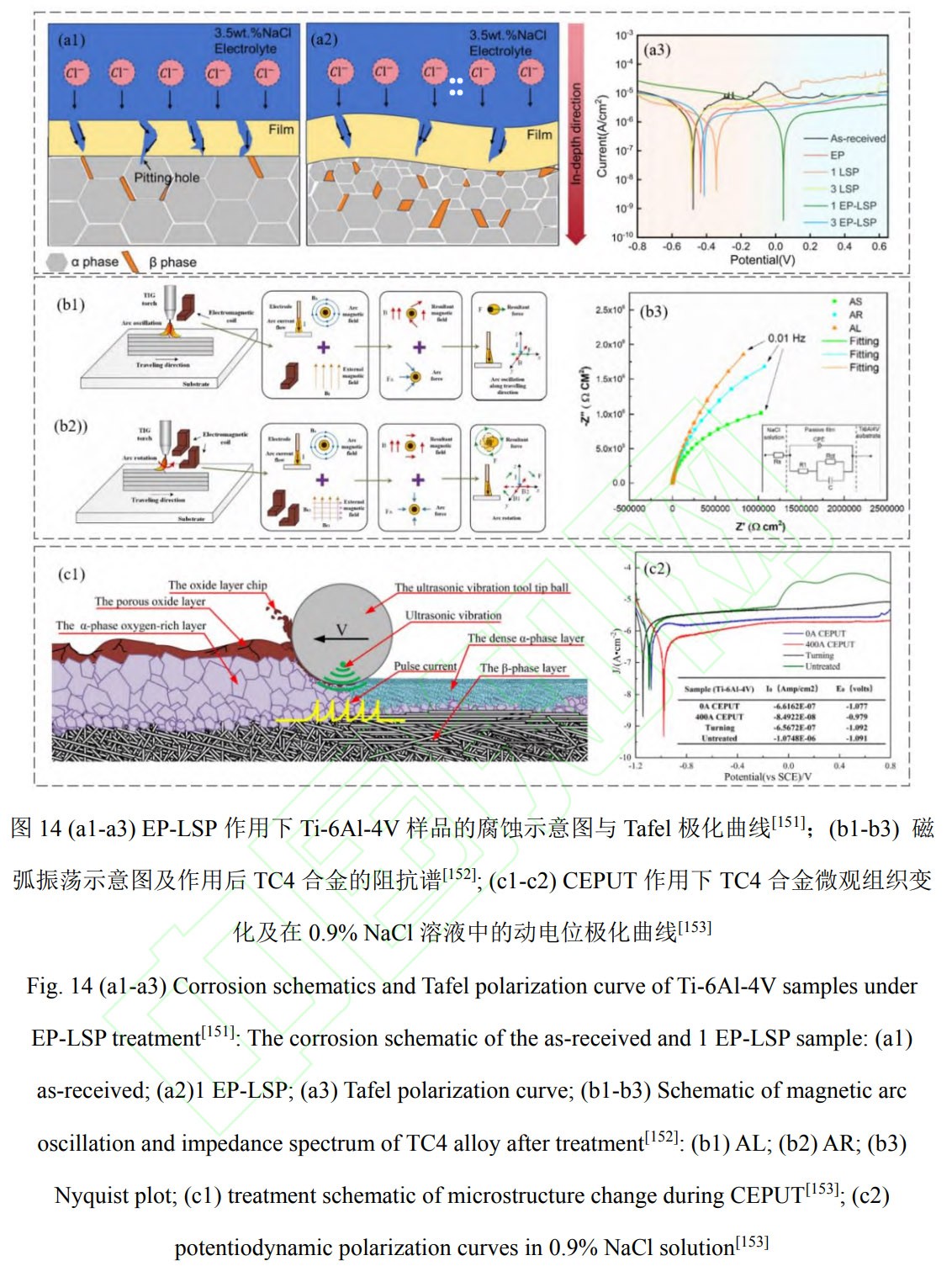
復(fù)合能量場(chǎng)成型技術(shù)通過(guò)多場(chǎng)協(xié)同作用優(yōu)化鈦合金的微觀結(jié)構(gòu)與表面狀態(tài),為提升耐腐蝕性提供了新途徑。LSP具有更高能量、高應(yīng)變率的特點(diǎn),不僅能改善材料的拉伸與疲勞性能[147,148],還可通過(guò)組織調(diào)控增強(qiáng)耐腐蝕性[149,150]。Jiang等[151]提出電脈沖聯(lián)合激光沖擊強(qiáng)化(Electro-pulsing Combined with Laser Shock Peening,EP-LSP)復(fù)合工藝,促使Ti-6Al-4V合金表面晶粒細(xì)化、 α相向 β相轉(zhuǎn)化,為鈍化膜提供更多形核位點(diǎn),加速形成均勻致密的鈍化膜(圖14(a1-a2)為原始態(tài)和1次EP-LSP樣品的腐蝕示意圖)。經(jīng)1次EP-LSP處理后,試樣的腐蝕電流密度降低,腐蝕電位提高,耐腐蝕性能提升(圖14(a3)為對(duì)應(yīng)的Tafel極化曲線)。除LSP技術(shù)外,磁弧振蕩也被用于優(yōu)化WAAM成型鈦合金的耐腐蝕性能。Wu等[152]在TC4沉積過(guò)程中引入弧旋轉(zhuǎn)(ArcRotation,AR)與弧縱向(Arc Longitudinal,AL)兩種磁弧振蕩模式(圖14(b1-b2)所示),相較于電弧穩(wěn)定(Arc Stability,AS)狀態(tài),磁弧振蕩可細(xì)化a片層,提高位錯(cuò)密度并強(qiáng)化晶粒取向集中。AL試樣表面形成約22nm鈍化膜與3nm過(guò)鈍化膜,結(jié)構(gòu)緊密無(wú)缺陷,能有效阻斷腐蝕介質(zhì)。電化學(xué)阻抗譜(Electrochemical Impedance Spectroscopy,EIS)(圖14b3)顯示, AR與AL試樣的電荷轉(zhuǎn)移電阻(Rct)遠(yuǎn)高于AS試樣,Nyquist圖中阻抗弧半徑更大,表明磁弧振蕩顯著提升了表面膜層的防護(hù)性能。此外,Ji等 [153]提出的耦合電脈沖和超聲處理(Coupled Electric Pulse and Ultrasonic Treatment,CEPUT)可以同步去除TC4鈦合金表面的疏松氧化層并生成致密α相層(圖14(c1)為CEPUT作用合金微觀組織變化)。經(jīng)400A峰值電流處理后,合金在0.9%NaCl溶液中的自腐蝕電流密度降低(如圖14(c2)所示),較未處理樣品降低兩個(gè)數(shù)量級(jí),耐腐蝕性大幅提升。
綜上所述,致密的微觀組織與穩(wěn)定的表面鈍化膜是提升AM鈦合金耐蝕性能的兩大核心要素。通過(guò)精準(zhǔn)的工藝參數(shù)調(diào)控與適配的熱處理,可進(jìn)一步增強(qiáng)鈍化膜的完整性與穩(wěn)定性;而采用多場(chǎng)協(xié)同調(diào)控技術(shù)細(xì)化晶粒并優(yōu)化表面致密度,能夠有效降低腐蝕電流密度,最終實(shí)現(xiàn)耐蝕性能的顯著提升。
參考文獻(xiàn)
[1]張玉棟,劉德寶,王俊青,等.增材制造鈦合金在生物醫(yī)用材料中的研究進(jìn)展[J].輕金屬.2025(03):30-42.
Zhang Y D, Liu D B, Wang Y Q, et al. Research progress of additive manufactured titanium alloys in biomedical materials[J]. Light Metals, 2025(03): 30-42.
[2]SRIVASTAVA M, JAYAKUMAR V, UDAYAN Y, et al. Additive manufacturing of Titanium alloy for aerospace applications: Insights into the process, microstructure, and mechanical properties[J]. Applied Materials Today, 2024, 41: 102481
[3]OLIVER-URRUTIA C, KASHIMBETOVA A, SLáMECKA K, et al. Robocasting additive manufacturing of titanium and titanium alloys: a review[J]. Transactions of the Indian Institute of Metals,2023,76(2):389-402
[4]WANG M, WANG Y, HE Q, et al. A strong and ductile pure titanium[J]. Materials Science and Engineering: A,2022,833: 142534
[5]SHAMIR M, JUNAID M, KHAN F N, et al. A comparative study of electrochemical corrosion behavior in Laser and TIG welded Ti-5Al-2.5 Sn alloy[J]. Journal of Materials Research and Technology,2019,8(1):87-98
[6]GAO T, XUE H, SUN Z, et al. Micromechanisms of crack initiation of a Ti-8Al-1Mo-1V alloy in the very high cycle fatigue regime[J]. International Journal of Fatigue, 2021, 150:106314
[7]LI M, WANG S, YU J, et al. Isothermal and thermomechanical fatigue behavior of Ti-2Al-2.5 Zr titanium alloy[J]. International Journal of Fatigue,2023, 177: 107923
[8]NI C, ZHU J, ZHANG B, et al. Recent advance in laser powder bed fusion of Ti-6Al-4V alloys: microstructure, mechanical properties and machinability[J]. Virtual and Physical Prototyping,2025,20(1):e2446952
[9]KHAN M A, JAFFERY S H I, KHAN M. Assessment of sustainability of machining Ti-6Al-4V under cryogenic condition using energy map approach[J]. Engineering Science and Technology, an International Journal, 2023, 41: 101357
[10]CHAI Z, WANG W Y, REN Y, et al. Hot deformation behavior and microstructure evolution of TC11 dual-phase titanium alloy[J]. Materials Science and Engineering: A, 2024, 898:146331
[11]LI G, SUN C. High-temperature failure mechanism and defect sensitivity of TC17 titanium alloy in high cycle fatigue[J]. Journal of Materials Science& Technology, 2022, 122: 128-140
[12]AWANNEGBE E, LI H, SONG T, et al. Microstructural characterisation and mechanical evaluation of Ti-15Mo manufactured by laser metal deposition[J]. Journal of Alloys and Compounds,2023,947:169553
[13]CHAMANFAR A, HUANG M-F, PASANG T, et al. Microstructure and mechanical properties of laser welded Ti-10V-2Fe-3Al(Ti1023) titanium alloy[J]. Journal of materials research andtechnology,2020,9(4):7721-7731
[14]ABBASI S, MOMENI A, LIN Y, et al. Dynamic softening mechanism in Ti-13V-11Cr-3Al beta Ti alloy during hot compressive deformation[J]. Materials Science and Engineering: A,2016,665:154-160
[15]YANG Y, CASTANY P, HAO Y, et al. Plastic deformation via hierarchical nano-sized martensitic twinning in the metastableβ Ti-24Nb-4Zr-8Sn alloy[J]. Acta Materialia, 2020,194:27-39
[16]周思雨,方明晨,楊光,等.超緩慢加熱處理對(duì)激光沉積制造 Ti-5Al-4Mo-3V-2Zr-Nb近 β鈦合金組織與性能的影響[J].中國(guó)激光,2024,51(20):252-259.
Zhou S Y, Fang M C, Yang G, et al. Effects of ultra-slow heating treatment on the microstructure and properties of laser-deposited Ti-5Al-4Mo-3V-2Zr-Nb near-β titanium alloy[J]. Chinese Journal of Lasers, 2024, 51(20): 252-259.
[17]RAVAL J, KAZI A, RANDOLPH O, et al. Machinability comparison of additively manufactured and traditionally wrought Ti-6Al-4V alloys using single-point cutting[J].Journal of Manufacturing Processes, 2023,(94): 539-549
[18]FEI-LONG Y, CHARLIE K, HAI-LIANG Y. Low-temperature superplasticity of cryorolled Ti-6Al-4V titanium alloy sheets[J].Tungsten,2023,5(4):522-530
[19]DEBROY T, WEI H L, ZUBACK J, et al. Additive manufacturing of metallic components-Process, structure and properties[J]. Progress in Materials Science,2018,92:pp.112-224.
[20]段偉.TC4合金SLM成形過(guò)程溫度場(chǎng)數(shù)值模擬及缺陷,組織與力學(xué)性能的研究[D];華中科技大學(xué),2020.
Duan W. Numerical simulation of temperature field, and research on defects, microstructure and mechanical properties during SLM forming of TC4 alloy[D]. Huazhong University of Science and Technology, 2020.
[21]MCANDREW A R, ALVAREZ ROSALES M, COLEGROVE P A, et al. Interpass rolling of Ti-6Al-4V wire+arc additively manufactured features for microstructural refinement[J].Additive Manufacturing,2018,21:340-349
[22]江奕良,孟憲凱,姚喆赫,等.鈦合金激光復(fù)合增材制造技術(shù)研究現(xiàn)狀[J].激光與光電子學(xué)進(jìn)展,2025,1-27:1006-4125.
Jiang Y L, Meng X K, Yao Z H, et al. Research status of laser hybrid additive manufacturing technology for titanium alloys[J]. Laser& Optoelectronics Progress,2025,1-27: 1006-4125.
[23]HAN K, TAN L, YAO C, et al. Study on the surface state induced by ultrasonic impact treatment and its influence on high-temperature tension-tension fatigue behavior[J]. Journal of Alloys and Compounds, 2025, 1010: 177602
[24]RICHTER B, HOCKER S J, FRANKFORTER E L,et al. Influence of ultrasonic excitation on the melt pool and microstructure characteristics of Ti-6Al-4V at powder bed fusion additive manufacturing solidification velocities[J]. Additive Manufacturing,2024,89:104228
[25]LU H, WU L, WEI H, et al. Microstructural evolution and tensile property enhancement of remanufactured Ti6Al4V using hybrid manufacturing of laser directed energy deposition with laser shock peening[J]. Additive Manufacturing, 2022, 55: 102877
[26]COLN B J, WATANABE K I, HOBBS T J, et al. Parameter development and characterization of laser powder directed energy deposition of Nb-Alloy C103 for thin wall geometries[J]. Journal of Materials Research and Technology, 2024, 30: 5028-5039
[27]TAN H, SHANG W, ZHANG F, et al. Process mechanisms based on powder flow spatial distribution in direct metal deposition[J]. Journal of Materials Processing Technology, 2018,254:361-372
[28]GHARBI M, PEYRE P, GORNY C, et al. Influence of various process conditions on surface finishes induced by the direct metal deposition laser technique on a Ti-6Al-4V alloy[J].Journal of materials processing technology,2013,213(5):791-800
[29]THAKKAR D, SAHASRABUDHE H. Investigating microstructure and defects evolution in laser deposited single-walled Ti-6Al-4V structures with sharp and non-sharp features[J].Journal of Manufacturing Processes, 2020, 56: 928-940
[30]WANG X, HE X, WANG T, et al. Internal pores in DED Ti-6.5 Al-2Zr-Mo-V alloy and their influence on crack initiation and fatigue life in the mid-life regime[J]. Additive Manufacturing,2019,28:373-393
[31]LI C, LIU J, LI S, et al. Evolutionary mechanism of solidification behavior in the melt pool during disk laser cladding with 316L alloy[J]. Coatings, 2024, 14(10): 1337
[32]CHENG J, XING Y, DONG E, et al. An overview of laser metal deposition for cladding:Defect formation mechanisms, defect suppression methods and performance improvements of laser-cladded layers[J]. Materials, 2022, 15(16): 5522
[33]CHENYANG H, JIAWEI C, YANYAN Z, et al. Powder scale multiphysics numerical
modelling of laser directed energy deposition[J]. 2021, 53(12): 3240-3251
[34]竺俊杰,王優(yōu)強(qiáng),倪陳兵,等.激光增材制造鈦合金微觀組織和力學(xué)性能研究進(jìn)展[J].表面技術(shù).2024,53(01):15-32.
Zhu J J, Wang Y Q, Ni C B, et al. Research progress on microstructure and mechanical properties of laser additive manufactured titanium alloys[J]. Surface Technology, 2024, 53(01):15-32.
[35]項(xiàng)煒明,王顥琦,彭凡,等.鈦合金激光選區(qū)熔化成形研究現(xiàn)狀與展望[J].中國(guó)有色金屬學(xué)報(bào).2024,34(08):2511-2529.
Xiang W M, Wang H Q, Peng F, et al. Research Status and Prospect of Selective Laser Melting Forming of Titanium Alloys[J]. The Chinese Journal of Nonferrous Metals, 2024,34(08):2511-2529.
[36]SCHWAB H, PALM F, KüHN U, et al. Microstructure and mechanical properties of the near-beta titanium alloy Ti-5553 processed by selective laser melting[J]. Materials& Design,2016,105:75-80
[37]毛雅梅,趙秦陽(yáng),耿紀(jì)華,等.粉末床熔融式增材制造鈦合金研究進(jìn)展及應(yīng)用[J].中國(guó)有色金屬學(xué)報(bào).2024,34(09):2831-2856.
Mao Y M, Zhao Q Y, Geng J H, et al. Research Progress and Applications of Titanium Alloys Fabricated by Powder Bed Fusion Additive Manufacturing[J]. The Chinese Journal of Nonferrous Metals,2024,34(09):2831-2856.
[38]DING D, PAN Z, CUIURI D,et al. Wire-feed additive manufacturing of metal components:technologies, developments and future interests[J]. The International Journal of Advanced Manufacturing Technology,2015,81(1):465-481
[39]陳超,張夢(mèng)瑩,李文龍,等.鈦合金熔絲增材制造的研究現(xiàn)狀與應(yīng)用領(lǐng)域[J].南京航空航天大學(xué)學(xué)報(bào)(自然科學(xué)版).2025,57(01):1-19.
Chen C, Zhang M Y, Li W L, et al. Research status and application fields of wire and arc additive manufacturing for titanium alloys[J]. Journal of Nanjing University of Aeronautics and Astronautics(Natural Science Edition), 2025, 57(01): 1-19.
[40]安飛鵬,李嘉琪,蔣鵬,等.CMT焊接技術(shù)在鈦合金領(lǐng)域的研究現(xiàn)狀[J].材料開發(fā)與應(yīng)用.2019,34(04):78-83+90.
An F P, Li J Q, Jiang P, et al. Research status of CMT welding technology in titanium alloy
field[J]. Development and Application of Materials, 2019, 34(04): 78-83+90.
[41]CHEN C, FENG T, ZHANG Y, et al. Improvement of microstructure and mechanical properties of TC4 titanium alloy GTAW based wire arc additive manufacturing by using interpass milling[J]. Journal of Materials Research and Technology, 2023, 27: 1428-1445
[42]TENG J, JIANG P, CONG Q, et al. A comparison on microstructure features, compression property and wear performance of TC4 and TC11 alloys fabricated by multi-wire arc additive manufacturing[J]. Journal of Materials Research and Technology, 2024, 29: 2175-2187
[43]LI Y Y, MA S Y, LIU C M, et al. Microstructure and mechanical properties of Ti-6.5Al-3.5Mo-1.5Zr-0.3Si alloy fabricated by arc additive manufacturing with post heat treatment[J]. Key Engineering Materials, 2018,789:161-169
[44]CHI J, CAI Z, WAN Z,et al. Effects of heat treatment combined with laser shock peening on wire and arc additive manufactured Ti17 titanium alloy: Microstructures, residual stress and mechanical properties[J]. Surface and coatings technology,2020,396: 125908
[45]KERFELDT P, COLLIANDER M H, PEDERSON R, et al. Electron backscatter diffraction characterization of fatigue crack growth in laser metal wire deposited Ti-6Al-4V[J]. Materials Characterization,2018,135:245-256
[46]BARRIOBERO-VILA P, REQUENA G, BUSLAPS T, et al. Role of element partitioning on the a+β phase transformation kinetics of a bi-modal Ti-6Al-6V-2Sn alloy during continuous heating[J]. Journal of alloys and compounds, 2015, 626: 330-339
[47]LI R, XIONG J, LEI Y. Investigation on thermal stress evolution induced by wire and arc additive manufacturing for circular thin-walled parts[J]. Journal of Manufacturing Processes,2019,40:59-67
[48]WANG F, LIU Y, ZHANG B, et al. Strengthening effect in laser metal deposited Ti-6Al-4V alloy via layer-by-layer ultrasonic impact treatment[J]. Materials Science and Engineering: A,2023,886:145693
[49]CHEN Y, XU M, ZHANG T, et al. Grain refinement and mechanical properties improvement of Inconel 625 alloy fabricated by ultrasonic-assisted wire and arc additive manufacturing[J].Journal of Alloys and Compounds, 2022, 910: 164957
[50]MARTINA F, COLEGROVE P A, WILLIAMS S W, et al. Microstructure of interpass rolled wire+arc additive manufacturing Ti-6Al-4V components[J]. Metallurgical and Materials
Transactions A,2015,46(12):6103-6118
[51]MARTINA F, ROY M, SZOST B, et al. Residual stress of as-deposited and rolled wire+arc additive manufacturing Ti-6Al-4V components[J]. Materials Science and Technology, 2016,32(14):1439-1448
[52]XU D, WANG J, WANG Z, et al. Elimination of defects in laser metal deposited TiCp/Ti6Al4V composite by synchronous ultrasonic impact treatment[J]. Materials Letters,2023,347:134635
[53]ZENG J, CHEN W, YAN W, et al. Effect of permanent magnet stirring on solidification of Sn-Pb alloy[J]. Materials& Design, 2016, 108: 364-373
[54]YUAN X, ZHOU T, REN W, et al. Nondestructive effect of the cusp magnetic field on the dendritic microstructure during the directional solidification of Nickel-based single crystal superalloy[J]. Journal of Materials Science& Technology, 2021, 62: 52-59
[55]于文澤,劉宇珂,王福斌,等.外場(chǎng)輔助定向能量沉積鈦合金研究進(jìn)展[J].中國(guó)有色金屬學(xué)報(bào).2024,34(08):2641-2660.
Yu W Z, Liu Y K, Wang F B,et al. Research Progress of External Field-Assisted Directed Energy Deposition of Titanium Alloys[J]. The Chinese Journal of Nonferrous Metals, 2024,34(08):2641-2660.
[56]TAN C, LI R, SU J, et al. Review on field assisted metal additive manufacturing[J].International Journal of Machine Tools and Manufacture, 2023, 189: 104032
[57]WANG H,HU Y,NING F,et al. Ultrasonic vibration-assisted laser engineered net shaping of Inconel 718 parts: Effects of ultrasonic frequency on microstructural and mechanical properties[J]. Journal of materials processing technology, 2020, 276: 116395
[58]李攀,郭順,楊東青,等.超聲振動(dòng)輔助電弧增材制造2219鋁合金的顯微組織及力學(xué)性能[J].中國(guó)有色金屬學(xué)報(bào).2023,33(07):2081-2089
Li P, Guo S, Yang D Q,et al. Microstructure and Mechanical Properties of 2219 Aluminium Alloy Fabricated by Ultrasonic Vibration-Assisted Arc Additive Manufacturing[J]. The Chinese Journal of Nonferrous Metals, 2023,33(07):2081-2089
[59]TODARO C,EASTON M,QIU D,et al. Grain structure control during metal 3D printing by high-intensity ultrasound[J]. Nature communications, 2020, 11(1): 142
[60]LEE Y, KIM E S, PARK S, et al. Effects of laser power on the microstructure evolution and
mechanical properties of Ti-6Al-4V alloy manufactured by direct energy deposition Metals and Materials International, 2022, 28(1): 197-204
[61]KISTLER N A, CORBIN D J, NASSAR A R, et al. Effect of processing conditions on the microstructure, porosity, and mechanical properties of Ti-6Al-4V repair fabricated by directed energy deposition[J]. Journal of Materials Processing Technology, 2019, 264: 172-181
[62]XUE A, LIN X, WANG L,et al. Heat-affected coarsening ofβ grain in titanium alloy during laser directed energy deposition[J]. Scripta Materialia, 2021, 205: 114180
[63]夏超.高功率激光定向能量沉積TA15合金強(qiáng)化熱處理研究[J].長(zhǎng)安大學(xué),2024.
Xia C. Study on Strengthening Heat Treatment of TA15 Alloy by High-Power Laser Directed Energy Deposition[D]. Changan University, 2024.
[64]艾佳華.激光定向能量沉積 Ti-1300合金組織與性能研究[J].哈爾濱工程大學(xué),2024.
Ai J H. Research on the microstructure and properties of Ti-1300 alloy fabricated by laser directed energy deposition[D]. Harbin Engineering University, 2024.
[65]WANG Z, LU G, LU H, et al. Tailoring laser directed energy deposited Ti6Al4V titanium alloy for superior and isotropic mechanical properties by interlayer pause-intertrack pause cooling strategy[J]. Additive Manufacturing,2025,97:104595
[66]ZHOU J, BARRETT R A, LEEN S B. Three-dimensional finite element modelling for additive manufacturing of Ti-6Al-4V components: Effect of scanning strategies on temperature history and residual stress[J]. Journal of Advanced Joining Processes, 2022, 5:100106
[67]ALI H, GHADBEIGI H, MUMTAZ K. Effect of scanning strategies on residual stress and mechanical properties of Selective Laser Melted Ti-6Al-4V[J]. Materials Science and Engineering:A,2018,712:175-187
[68]ZHANG W, TONG M, HARRISON N M. Scanning strategies effect on temperature, residual stress and deformation by multi-laser beam powder bed fusion manufacturing[J]. Additive Manufacturing,2020,36:101507
[69]WANG Z, LU G, BIAN H, et al. Parameter optimization and anisotropy mechanism in different build directions of the microstructures and mechanical properties for laser directed energy deposited Ti6Al4V alloy[J]. Materials Science and Engineering: A,2024,911: 146906
[70]DONG W, DU M, WANG S, et al. Achieving green and ultra-strong bonding between metals
and polymers through additive manufacturing[J]. Materials Today Communications, 2024,39-109152.
[71]周建新,黨理想,張惠乾,等.鈦合金增材制造工藝的研究進(jìn)展[J].材料開發(fā)與應(yīng)用.2025,40(02):1-19.
Zhou J X, Dang L X, Zhang H Q, et al. Research progress of additive manufacturing processes for titanium alloys[J]. Development and Application of Materials, 2025, 40(02):1-19.
[72]楊三強(qiáng),王磊,李茂偉,等.鈦合金零件殘余應(yīng)力消除及形狀精度保持性研究[J].材料開發(fā)與應(yīng)用.2024,39(04):76-82.
Yang S Q, Wang L, Li M W, et al. Research on residual stress elimination and shape accuracy retention of titanium alloy parts[J]. Development and Application of Materials, 2024, 39(04):76-82.
[73]榮鵬,成靖,鄧?guó)櫸模?不同熱處理對(duì)激光定向能量沉積制造TC4鈦合金組織和拉伸性能的影響[J].機(jī)械工程學(xué)報(bào),2024,60(20):99-107.
Rong P, Cheng J, Deng H W, et al. Effects of different heat treatments on the microstructure and tensile properties of TC4 titanium alloy fabricated by laser directed energy deposition[J].Journal of Mechanical Engineering, 2024, 60(20): 99-107.
[74] DING H, WANG L, LIN X, et al. Simultaneously enhancing strength and toughness of heat-treated nearβ titanium alloy fabricated by laser-directed energy deposition[J]. Materials Science and Engineering: A, 2022, 855: 143907
[75]曾宙,劉奮成,劉豐剛,等.多重?zé)崽幚韺?duì)激光定向能量沉積TB6鈦合金組織和力學(xué)性能的影響[J].中國(guó)激光,2025,52(20):145-156
Zeng Z, Liu F C, Liu F G, et al. Effect of multiple heat treatments on microstructure and mechanical properties of TB6 titanium alloy fabricated by laser directed energy deposition[J].Chinese Journal of Lasers, 2025, 52(20): 145-156
[76] TANG M, PISTORIUS P C, BEUTH J L. Prediction of lack-of-fusion porosity for powder bed fusion[J]. Additive Manufacturing, 2017, 14:39-48
[77] CUNNINGHAM R, NARRA S P, MONTGOMERY C, et al. Synchrotron-based X-ray microtomography characterization of the effect of processing variables on porosity formation in laser power-bed additive manufacturing of Ti-6Al-4V[J]. Jom, 2017, 69(3): 479-484
[78]GONG H, RAFI K, GU H, et al. Analysis of defect generation in Ti-6Al-4V parts made using powder bed fusion additive manufacturing processes. Addit Manuf 1-4: 87-98[Z]. 2014
[79]ZHAO R, CHEN C, WANG W, et al. On the role of volumetric energy density in the microstructure and mechanical properties of laser powder bed fusion Ti-6Al-4V alloy[J].Additive Manufacturing,2022,51:102605
[80]LIU B, FANG G, LEI L. An analytical model for rapid predicting molten pool geometry of selective laser melting(SLM)[J]. Applied Mathematical Modelling, 2021, 92: 505-524
[81]ZHANG L, KLEMM D, ECKERT J, et al. Manufacture by selective laser melting and mechanical behavior of a biomedical Ti-24Nb-4Zr-8Sn alloy[J]. Scripta Materialia, 2011,65(1):21-24
[82]CAI C, WU X, LIU W, et al. Selective laser melting of near-a titanium alloy Ti-6Al-2Zr-1Mo-1V: Parameter optimization, heat treatment and mechanical performance[J].Journal of Materials Science& Technology, 2020, 57: 51-64
[83]LIVERANI E, TOSCHI S, CESCHINI L, et al. Effect of selective laser melting(SLM)process parameters on microstructure and mechanical properties of 316L austenitic stainless steel[J]. Journal of Materials Processing Technology,2017, 249: 255-263
[84]WEI K, WANG Z, ZENG X. Preliminary investigation on selective laser melting of Ti-5Al-2.5 Sn a-Ti alloy: From single tracks to bulk 3D components[J]. Journal of Materials Processing Technology,2017,244:73-85
[85]GUAN J, WANG Q. Laser powder bed fusion of dissimilar metal materials: a review[J].Materials,2023,16(7):2757
[86]PANWISAWAS C, QIU C, SOVANI Y, et al. On the role of thermal fluid dynamics into the evolution of porosity during selective laser melting[J]. Scripta Materialia, 2015, 105: 14-17
[87]QIU C, PANWISAWAS C, WARD M, et al. On the role of melt flow into the surface structure and porosity development during selective laser melting[J]. Acta Materialia, 2015, 96: 72-79
[88]ZHANG J-Q, WANG M-J, LIU J-Y, et al. Influence of scanning strategy on printing quality and properties of selective laser melted 18Ni300 maraging steel[J]. Journal of Materials Engineering,2020,48(10):105-113
[89]CAO X, CARTER L N, VILLAP N V M, et al. Optimisation of single contour strategy in selectivelasermeltingofTi-6Al-4Vlattices[J].RapidPrototypingJournal,2022,28(5):
907-915
[90]陳德寧,劉婷婷,廖文和,等.掃描策略對(duì)金屬粉末選區(qū)激光熔化溫度場(chǎng)的影響[J].中國(guó)激光.2016,43(04):403003.
Chen D N, Liu T T, Liao W H, et al. Effect of scanning strategies on the temperature field of selective laser melting of metal powders[J]. Chinese Journal of Lasers, 2016, 43(04): 403003.
[91]SHI W, LI J, JING Y, et al. Combination of scanning strategies and optimization experiments for laser beam powder bed fusion of Ti-6Al-4V titanium alloys[J]. Applied Sciences, 2022,12(13):6653
[92]YAN X, SHI C, LIU T, et al. Effect of heat treatment on the corrosion resistance behavior of selective laser melted Ti6Al4V ELI[J]. Surface and Coatings Technology, 2020, 396: 125955
[93]THIJS L, VERHAEGHE F, CRAEGHST, et al. A study of the microstructural evolution during selective laser melting of Ti-6Al-4V[J]. Acta materialia, 2010, 58(9): 3303-3312
[94]魏青松,周燕,朱文志,等.粉末床激光選區(qū)熔化成形典型金屬材料的組織與性能[J].北京:國(guó)防工業(yè)出版社,2021.
Wei Q S, Zhou Y, Zhu W Z, et al. Microstructure and Properties of Typical Metal Materials Formed by Selective Laser Melting in Powder Bed[M]. National Defense Industry Press,2021.
[95]CARROZZA A, AVERSA A, FINO P, et al. A study on the microstructure and mechanical properties of the Ti-6Al-2Sn-4Zr-6Mo alloy produced via Laser Powder Bed Fusion[J].Journal of Alloys and Compounds,2021,870:159329
[96]HUANG W, HE D, WANG H, et al. The effect of heat treatment on the anisotropy of Ti-6Al-4V by selective laser melting[J]. Jom, 2022, 74(7): 2724-2732
[97]LI C-L, HONG J K, NARAYANA P, et al. Realizing superior ductility of selective laser melted Ti-6Al-4V through a multi-step heat treatment[J]. Materials Science and Engineering:A,2021,799:140367
[98]WANG C, LI C, CHEN R, et al. Multistep low-to-high-temperature heating as a suitable alternative to hot isostatic pressing for improving laser powder-bed fusion-fabricated Ti-6Al-2Zr-1Mo-1V microstructural and mechanical properties[J]. Materials Science and Engineering: A,2022,841:143022
[99]YAO P, ZHOU K, ZHU Q. Quantitative evaluation method of arc sound spectrum based on
sample entropy[J]. Mechanical Systems and Signal Processing, 2017, 92: 379-390
[100]孫清潔,康克新,余紅武,等.Ti60合金磁場(chǎng)輔助TIG電弧熔粉增材制造工藝[J].焊接學(xué)報(bào),2015:1-8.
Sun Q J, Kang K X, Yu H W, et al. Magnetic Field-Assisted TIG Arc Powder Deposition Additive Manufacturing Process for Ti60 Alloy[J]. Transactions of the China Welding Institution,2025:1-8.
[101]LIU H, FENG T, CHEN C, et al. Study on the relationship between process parameters and TheFormation of GTAW additive manufacturing of TC4 titanium alloy using the response surface method[J]. Coatings,2023,13(9):1578
[102] WU B, PAN Z, DING D, et al. The effects of forced interpass cooling on the material properties of wire arc additively manufactured Ti6Al4V alloy[J]. Journal of Materials Processing Technology,2018,258:97-105
[103]高震,王穎,楊蔚然,等.熱輸入對(duì)脈沖TIG電弧增材制造Ti6Al4V鈦合金微觀組織與力學(xué)性能的影響[J].中國(guó)有色金屬學(xué)報(bào).2024,34(10):3366-3381.
Gao Z, Wang Y, Yang W R, et al. Effects of Heat Input on Microstructure and Mechanical Properties of Ti6Al4V Titanium Alloy Fabricated by Pulsed TIG Arc Additive Manufacturing[J]. The Chinese Journal of Nonferrous Metals, 2024, 34(10): 3366-3381.
[104]OGINO Y, ASAI S, HIRATA Y. Numerical simulation of WAAM process by a GMAW weld pool model[J]. Welding in the World, 2018, 62(2): 393-401
[105]HE B, WANG Y, WANG C, et al. Effect of gradient decrease heat-input combined with inter-layer cooling on microstructure and mechanical properties of WAAM-Ti-6Al-2Zr-1Mo-1V alloy[J]. Materials Today Communications, 2024, 39: 108628
[106]WANG J, LIN X, LI J, et al. Effects of deposition strategies on macro/microstructure and mechanical properties of wire and arc additive manufactured Ti6Al4V[J]. Materials Science and Engineering: A,2019,754:735-749
[107]黃健康,吳昊盛,于曉全,等.鈦合金電弧增材制造工藝及微觀組織調(diào)控的研究現(xiàn)狀[J].材料導(dǎo)報(bào).2023,37(14):101-106.
Huang J K, Wu H S, Yu X Q,et al. Research status of arc additive manufacturing process and microstructure regulation of titanium alloys[J]. Materials Review, 2023, 37(14): 101-106.
[108]張帥鋒,呂逸帆,魏正英,等.熱處理對(duì)CMT電弧熔絲增材制造Ti-6Al-3Nb-2Zr-1Mo合
金顯微組織和力學(xué)性能的影響[J].鈦工業(yè)進(jìn)展.2022,39(03):11-16.
Zhang S F, Lü Y F, Wei Z Y, et al. Microstructure and properties of Ti-6Al-3Nb-2Zr-1Mo alloy fabricated by CMT-based wire and arc additive manufacturing[J]. Transactions of the China Welding Institution,2022,39(03):11-16.
[109] LIN Z, SONG K, DI CASTRI B, et al. Microstructure-gradient approach for effective determination of post-heat treatment temperature of an additive manufactured Ti-6Al-4V sample[J]. Journal of Alloys and Compounds, 2022, 921: 165630
[110]WANG J, LIN X, WANG M, et al. Effects of subtransus heat treatments on microstructure features and mechanical properties of wire and arc additive manufactured Ti-6Al-4V alloy[J].Materials Science and Engineering: A,2020, 776: 139020
[111]CHEN Y, ZHANG X, DING D, et al. Integration of interlayer surface enhancement technologies into metal additive manufacturing:A review[J]. Journal of Materials Science&Technology,2023,(34):94-122
[112]許明方,陳玉華,鄧懷波,等.超聲輔助CMT電弧增材制造TC4鈦合金微觀組織和力學(xué)性能研究[J].精密成形工程.2019,11(05):142-148.
Xu M F, Chen Y H, Deng H B, et al. Study on Microstructure and Mechanical Properties of TC4 Titanium Alloy Fabricated by Ultrasonic-Assisted CMT Arc Additive Manufacturing[J].Journal of Netshape Forming Engineering, 2019, 11(05): 142-148.
[113]HE L, WU M, LI L, et al. Ultrasonic generation by exciting electric arc: A tool for grain refinement in welding process[J]. Applied Physics Letters, 2006, 89(13)
[114]YANG Y, JIN X, LIU C,et al. Residual stress, mechanical properties, and grain morphology of Ti-6Al-4V alloy produced by ultrasonic impact treatment assisted wire and arc additive manufacturing[J]. Metals, 2018,8(11):934
[115]CHEN Z, CUI X, YU M, et al. Microstructure evolution and strengthening mechanisms of laser directed energy deposited TA15 titanium alloy with synchronous ultrasonic impact[J].Journal of Alloys and Compounds, 2025: 182407
[116]YANG X, ZHOU J, LING X. Study on plastic damage of AISI 304 stainless steel induced by ultrasonic impact treatment[J]. Materials& Design(1980-2015),2012,36:477-481
[117]孟憲凱,張正燁,周建忠,等.激光噴丸強(qiáng)化TC6鈦合金的振動(dòng)疲勞壽命及斷口形貌分析[J].航空制造技術(shù).2022,65(04):73-79.
Meng X K,Zhang Z Y,Zhou J Z,et al. Vibration fatigue life and fracture morphology analysis of TC6 titanium alloy strengthened by laser peening[J]. Aeronautical Manufacturing Technology,2022,65(04):73-79.
[118]周祥曼,張海鷗,王桂蘭,等.縱向穩(wěn)態(tài)磁場(chǎng)輔助電弧增材制造的熔池?cái)?shù)值模擬及搭接實(shí)驗(yàn)研究[J].第16屆全國(guó)特種加工學(xué)術(shù)會(huì)議集(下)北京:中國(guó)機(jī)械工程學(xué)會(huì)特種加工分會(huì),2015:333-345.
Zhou X M, Zhang H O, Wang G L,et al. Numerical Simulation of Molten Pool and Lap Joint Experiment in Arc Additive Manufacturing Assisted by Longitudinal Steady Magnetic Field[C]. Proceedings of the 16th National Conference on Non-traditional Machining(Volume 2).Beijing: Special Machining Branch of Chinese Mechanical Engineering Society, 2015:333-345.
[119]趙旭山,王元?jiǎng)祝顫?rùn)聲,等.磁場(chǎng)輔助電弧增材制造邊緣焊道流淌抑制研究[J].華中科技大學(xué)學(xué)報(bào)(自然科學(xué)版),2024,52(12):27-36.
Zhao X S, Wang Y X, Li R S, et al. Study on Suppression of Edge Bead Sagging in Magnetic Field-Assisted Arc Additive Manufacturing[J]. Journal of Huazhong University of Science and Technology(Natural Science Edition), 2024, 52(12): 27-36.
[120]周祥曼,田啟華,杜義賢,等.外加橫向磁場(chǎng)作用電弧增材成形過(guò)程中的傳熱傳質(zhì)仿真[J].機(jī)械工程學(xué)報(bào).2018,54(12):193-206.
Zhou X M, Tian Q H, Du Y X, et al. Simulation of Heat and Mass Transfer in Arc Additive Forming Process Under the Action of External Transverse Magnetic Field[J]. Journal of Mechanical Engineering,2018,54(12):193-206.
[121]ZHAO R, CHEN C, SHUAI S, et al. Enhanced mechanical properties of Ti6Al4V alloy fabricated by laser additive manufacturing under static magnetic field[J]. Materials Resarch Letters,2022,10(8):530-538
[122]ZHAO R, WANG J, CAO T, et al. Additively manufactured Ti-6Al-4V alloy by high magnetic field heat treatment[J]. Materials Science and Engineering: A,2023,871: 144926
[123]DENG M, SUI S, YAO B, et al. Microstructure and room-temperature tensile property of Ti-5.7 Al-4.0Sn-3.5Zr-0.4Mo-0.4Si-0.4Nb-1.0Ta-0.05C with near equiaxedβ grain fabricated by laser directed energy deposition technique[J]. Journal of Materials Science& Technology, 2022,101:308-320
[124]WU D, TIAN J, LIAO M, et al. Study on the effect of variable laser power on residual stress distribution in laser directed energy deposition of Ti-6Al-4V[J]. CIRP Journal of Manufacturing Science and Technology,2024,55:322-332
[125]胡勇,馬好放,張文格,等.掃描策略對(duì)粉末床熔融構(gòu)件殘余應(yīng)力、微觀組織和力學(xué)性能影響的研究進(jìn)展[J].中國(guó)有色金屬學(xué)報(bào).2025,35:2050-2068.
Hu Y, Ma H F, Zhang W G, et al. Research Progress on the Effects of Scanning Strategies on Residual Stress, Microstructure and Mechanical Properties of Powder Bed Fusion Components[J]. Chinese Journal of Nonferrous Metals, 2025, 35(06): 2050-2068.
[126]萬(wàn)里,楊敏,郭敏,等.激光粉末床熔融熱-流及微觀組織模擬關(guān)鍵模型研究進(jìn)展[J].中國(guó)有色金屬學(xué)報(bào),2025:1-39.
Wan L, Yang M, Guo M, et al. Research Progress on Key Models for Thermo-Fluid and Microstructure Simulation in Laser Powder Bed Fusion[J]. Chinese Journal of Nonferrous Metals,2025:1-39.
[127]PANWISAWAS C, TANG Y T, REED R C. Metal 3D printing as a disruptive technology for superalloys[J]. Nature communications, 2020, 11(1): 2327
[128]. Multiphysics Modeling and Characterizing Melt Pool Formation during Laser-based Powder Bed Fusion(L-PBF) of Ti-6Al-4V[D];對(duì)衛(wèi),2023.
[129]YIN J, PENG G, CHEN C, et al. Thermal behavior and grain growth orientation during selective laser melting of Ti-6Al-4V alloy[J]. Journal of Materials Processing Technology,2018,260:57-65
[130]CHENG B, SHRESTHA S, CHOU K. Stress and deformation evaluations of scanning strategy effect in selective laser melting[J]. Additive Manufacturing, 2016, 12: 240-251
[131]ZHOU J, HAN X, LI H, et al. Investigation of layer-by-layer laser remelting to improve surface quality, microstructure, and mechanical properties of laser powder bed fused AlSi10Mg alloy[J]. Materials& Design, 2021, 210: 110092
[132] LI G, LIU W, LIANG L, et al. Preparing Sr-containing nano-structures on micro-structured titanium alloy surface fabricated by additively manufacturing to enhance the anti-inflammation and osteogenesis[J]. COLLOIDS AND SURFACES B-BIOINTERFACES,2022,218 112762.
[133] LI Z, GREENWOOD M, MIRANDA J, et al. Prediction of columnar and equiaxed grain
morphologies during wire arc additive manufacturing of a Ti-Al-Fe-V alloy[J]. Progress in Additive Manufacturing, 2025: 1-12
[134]劉國(guó)昌.激光電弧復(fù)合增材制造路徑規(guī)劃計(jì)算機(jī)仿真及工藝研究[D];長(zhǎng)春理工大學(xué),2020.
Liu G C. Computer simulation and process research on path planning of laser-arc hybrid additive manufacturing[D]. Changchun University of Science and Technology,2020.
[135]ZHAO Z, GUO Y, DU W, et al. Corrosion behavior of SiC/Ti6Al4V titanium matrix composites fabricated by SLM[J]. Journal of Materials Research and Technology, 2024, 31:534-542
[136] LU X, ZOU W, ZHOU X, et al. Effect of process parameters on mechanical properties and corrosion resistance of Ti-6Al-4V alloys prepared by selective laser melting[J]. Journal of Materials Research and Technology,2025,36:1743-1757
[137]DAI N, ZHANG L-C, ZHANG J, et al. Distinction in corrosion resistance of selective laser melted Ti-6Al-4V alloy on different planes[J]. Corrosion Science, 2016, 111: 703-710
[138]LONGHITANO G A, ARENAS M A, CONDE A, et al. Heat treatments effects on functionalization and corrosion behavior of Ti-6Al-4V ELI alloy made by additive manufacturing[J]. Journal of Alloys and Compounds, 2018, 765: 961-968
[139]LI L, CHEN Y, LU Y, et al. Effect of heat treatment on the corrosion resistance of selective laser melted Ti-6Al-4V-3Cu alloy[J]. Journal of Materials Research and Technology,2021, 12:904-915
[140]ANANTHARAM G, NAIR R, SIVAN A, et al. Effect of post-processing on the corrosive behaviour of L-DED Ti-6Al-4V[J]. Materials Letters, 2024, 373: 137143
[141]MARTIN, AZZI M, SALISHCHEV G, et al. Influence of microstructure and texture on the corrosion and tribocorrosion behavior of Ti-6Al-4V[J]. Tribology International, 2010, 43(5-6):918-924
[142] SU B, LUO L, WANG B, et al. Annealed microstructure dependent corrosion behavior of Ti-6Al-3Nb-2Zr-1Mo alloy[J]. Journal of Materials Science& Technology, 2021, 62:234-248
[143]LU J, GE P, LI Q, et al. Effect of microstructure characteristic on mechanical properties and corrosion behavior of new high strength Ti-1300 beta titanium alloy[J]. Journal of Alloys and
Compounds,2017,727:1126-1135
[144]WANG Z, HU H, ZHENG Y, et al. Comparison of the corrosion behavior of pure titanium and its alloys in fluoride-containing sulfuric acid[J]. Corrosion Science, 2016, 103: 50-65
[145]CHENG H, LUO H, CHENG J, et al. Optimizing the corrosion resistance of additive manufacturing TC4 titanium alloy in proton exchange membrane water electrolysis anodic environment[J]. International Journal of Hydrogen Energy, 2024, 93: 753-769
[146]CHEN Z, LIANG Y, XU C, et al. Improving the product of strength and ductility and corrosion resistance by adding He shielding gas in the CMT additive manufacturing process of Ti6Al4V[J]. Journal of Alloys and Compounds, 2024, 1005: 176078
[147]SUN R, LI L, ZHU Y, et al. Fatigue of Ti-17 titanium alloy with hole drilled prior and post to laser shock peening[J]. Optics& Laser Technology, 2019, 115: 166-170
[148]GUO W, SUN R, SONG B, et al. Laser shock peening of laser additive manufactured Ti-6Al-4V titanium alloy[J]. Surface and coatings technology,2018, 349:503-510
[149]WANG H, NING C, HUANG Y, et al. Improvement of abrasion resistance in artificial seawater and corrosion resistance in NaCl solution of 7075 aluminum alloy processed by laser shock peening[J]. Optics and Lasers in Engineering,2017,90:179-185
[150]MIRONOV S, OZEROV M, KALINENKO A, et al. On the relationship between microstructure and residual stress in laser-shock-peened Ti-6Al-4V[J]. Journal of Alloys and Compounds,2022,900:163383
[151] JIANG R, ZHANG S, QIU X, et al. Effects of electro-pulsing combining laser shock peening on the microstructure and corrosion resistance of Ti-6Al-4 V alloy[J]. The International Journal of Advanced Manufacturing Technology, 2024, 134(5): 2607-2622
[152]WU B, SHAO Z, SHAO D, et al. Enhanced corrosion performance in Ti-6Al-4V alloy produced via wire-arc directed energy deposition with magnetic arc oscillation[J]. Additive Manufacturing,2023,66:103465
[153] JI R, WANG H, WANG B, et al. Removing loose oxide layer and producing dense a-phase layer simultaneously to improve corrosion resistance of Ti-6Al-4V titanium alloy by coupling electrical pulse and ultrasonic treatment[J]. Surface and Coatings Technology, 2020, 384:125329
(注,原文標(biāo)題:鈦合金增材制造技術(shù)及組織性能研究進(jìn)展)
tag標(biāo)簽:鈦合金,增材制造,多元化發(fā)展,精準(zhǔn)調(diào)控,單一能量場(chǎng),復(fù)合能量場(chǎng)